



Shakedown Cruise: Testing Your Boat & Engine in Spring
Spring shakedowns are about catching problems at the dock or close to home before they strand you ten miles offshore. After twenty years wrenching on outboards, I can tell you most issues we see in April could've been spotted in a one-hour test run. Let's get into what you actually need to check.
Pre-Launch Inspection
Before you turn the key, walk the boat and trailer. Check trailer tire pressure and look at the wheel bearings—if the dust cap is loose or greasy, pull it and inspect the bearing. A seized bearing will cook your hub before you hit the launch ramp.
Hull and transom: Look for cracks, especially around the transom where the outboard mounts. Gelcoat spiders are common after freeze-thaw cycles. Pull the drain plug and make sure it's not cross-threaded. We've had customers launch with no plug because someone stripped the threads and jammed it in anyway.
Fuel system: Pop the cowling and smell the engine compartment. If you catch fuel vapors before you start, you've got a leak—find it now. Check fuel lines for cracks where they bend at the tank and primer bulb. Ethanol blends cause phase separation after about 90 days in storage. If your tank sat all winter with E10, you might see a cloudy, separated layer at the bottom. That's water and alcohol, and it'll choke your engine. Drain it or siphon it out before you run. For detailed info on fuel issues, see our guide on Spotting Outboard Fuel Leaks and Fixing Them Safely.
Battery: Use a multimeter. At rest, a good battery shows 12.6V. Under load (cranking), it shouldn't drop below 10V. If it does, replace it. A weak battery will turn the starter slow, and a slow starter won't spin the flywheel fast enough to fire the engine.
Eight Critical Checkpoints
Here's the list. Miss one, and you're asking for a tow.
1. Engine Cooling System
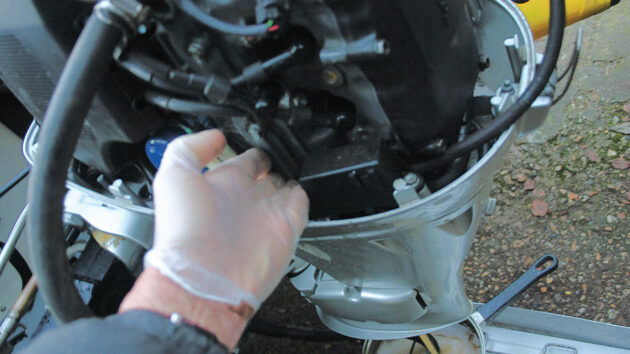
Start the engine and immediately check the tell-tale stream (the pee stream). It should be strong and steady at idle—think garden hose, not dribble. If it's weak at idle but picks up when you throttle, your impeller is worn or you've got a partial blockage in the cooling passage. If there's no stream at all, shut down. You're overheating.
Water spits at idle but improves with throttle: Classic sign of an impeller with missing vanes. The remaining vanes can move enough water at higher RPM, but they can't pull enough at low speed. Replace the impeller. Don't wait. Learn more about impeller replacement in our post on Signs Your Outboard Impeller Needs Replacement.
Pull the lower unit's water pump cover and inspect the impeller every 200 hours or every two years, whichever comes first. The rubber gets hard and the vanes crack. For parts, check our Water Pump Impeller Kits.
2. Steering System
Turn the wheel lock to lock at the dock. Does it bind or catch? On hydraulic steering, check the fluid reservoir—it should be full and clean, not milky. Milky fluid means water intrusion.
On cable steering, the cable can seize if the grease hardens over winter. Last spring, we had a guy whose cable froze mid-turn because he never greased the tube. A quick check at the dock would've caught it. While you're underway, make small corrections and feel for slop. More than an inch of play at the wheel means the cable or tie bar bushings are shot.
3. Fuel Delivery
Squeeze the primer bulb. It should firm up after a few pumps and stay firm. If it stays soft, you're pulling air—check hose clamps at the tank, the bulb itself, and the engine connection.
Clogged fuel filter symptoms: The engine will start fine but bog down under load, or it'll run rough at mid-throttle. Pull the inline filter and hold it to the light. If you see debris or gel (that's oxidized gas and ethanol varnish), replace it. We keep spare filters in every tool bag for this exact reason. Browse our Fuel Filter collection for replacements.
4. Propeller and Lower Unit
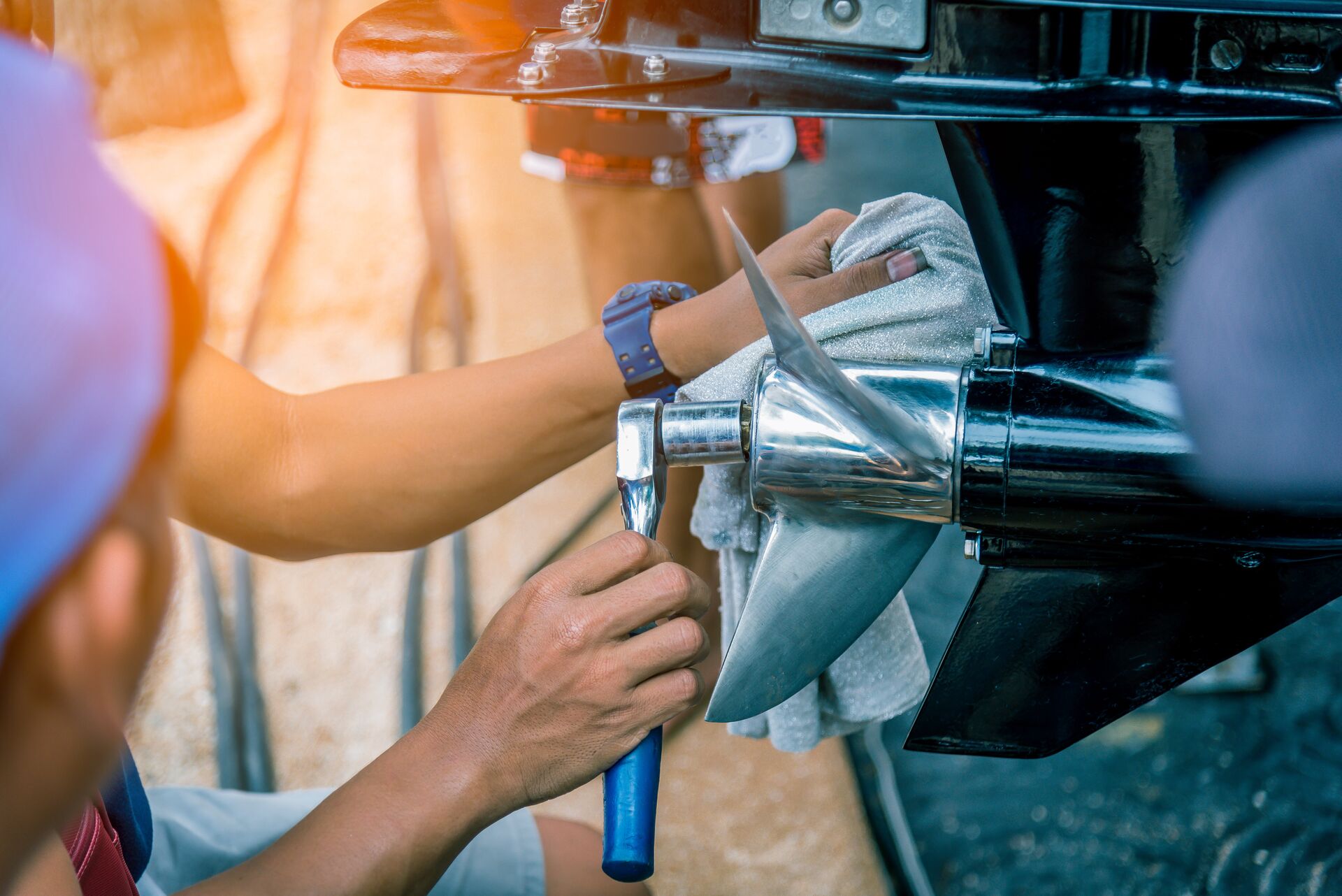
Pull the boat and inspect the prop. Look for dings, bent blades, or fishing line wrapped around the shaft. A single ding throws off the balance and causes vibration, which wears the seals in the lower unit. We've seen guys ignore a bent prop all season and then wonder why their lower unit is leaking.
Check the prop nut. It should be tight, and the cotter pin should be in place. Spin the prop by hand—it should turn smoothly. If it's notchy or grinds, your lower unit bearings are going. Learn to spot issues in our Propeller Vibrations: Diagnosing Bent Shafts or Blades article.
Zinc anodes: If you run in saltwater, check the trim tab anode and the one on the lower unit. If they're more than 50% gone, replace them. Zincs are cheap. New lower units are not.
5. Electrical System and Bilge Pump
Test the bilge pump manually first. Flip the dash switch—does the pump run? Now lift the float switch by hand. If the pump doesn't engage automatically, the float is stuck or the switch is dead. Pour a gallon of water into the bilge and let the float trip it. We've had customers take on water because they tested the manual switch but never checked the float.
Navigation lights: Turn on your running lights and walk around the boat. Check red, green, and stern white. If one's out, it's usually a corroded bulb socket. Pull the bulb, hit the socket with contact cleaner, and reinstall. LED bulbs last longer and pull less current.
Test the VHF radio. Call a buddy or hail the local marina. If you're getting static or no response, check the antenna connection at the base. Corrosion builds up over winter.
6. Safety Equipment
Life jackets: Count them. You need one wearable PFD per person, and they need to be Coast Guard-approved and in good shape. Check for rips, broken zippers, or missing straps. If the foam is compressed or cracked, toss it.
Fire extinguisher: Read the gauge. If the needle is in the red (undercharged), replace it or recharge it. Most cheap extinguishers can't be recharged—just buy a new one. Make sure it's mounted in a bracket, not rolling around in a locker. In a fire, you need it in your hand in two seconds.
First-aid kit: Open it. Check for expired medication, dried-out antiseptic wipes, and missing bandages. Add a tourniquet if you don't have one. Prop strikes happen.
Flares: Check the expiration date stamped on the tube. The Coast Guard won't accept expired flares, and they won't ignite reliably. If they're more than 42 months old, replace them.
7. Throttle and Shift Controls
At the dock, run through the shift pattern. Neutral should click into place, and forward/reverse should engage without grinding. If the shifter is stiff or you hear a clunk when you shift, the shift cable needs adjustment or the lower unit clutch dog is worn.
Test the throttle. It should move smoothly from idle to wide-open. If it sticks, spray the cable ends with penetrating oil and work it back and forth. A sticky throttle can cause a runaway engine, and that's a good way to hit the dock.
Kill switch (engine cut-off switch): Clip the lanyard to your belt and yank it while the engine is running. The engine should die immediately. If it doesn't, the switch is bad. Replace it. This is the one thing that'll save you if you go overboard. For more on throttle and shift care, see Upgrading Your Throttle and Shift Controls for Smoother Response.
8. Underway Systems Test
Once you're off the dock, run the boat through the full RPM range, but do it in steps. Idle for ten minutes first and listen. Any rattles, hisses, or knocks need to be tracked down. Then bring it up to 3500 RPM and hold it there for fifteen minutes. This is where cooling issues, fuel starvation, and ignition problems show up.
Trim tabs: If you've got them, cycle them up and down. They should respond evenly. If one side lags, check the hydraulic lines and actuator. Air in the system will cause sluggish movement.
Gauges: Watch your tach, temp, and oil pressure (if equipped). RPM should climb smoothly with throttle. Temp should stabilize around 140–160°F on most outboards. Oil pressure should hold steady—if it fluctuates or drops, shut down and check the oil level and filter.
Post-Shakedown Inspection
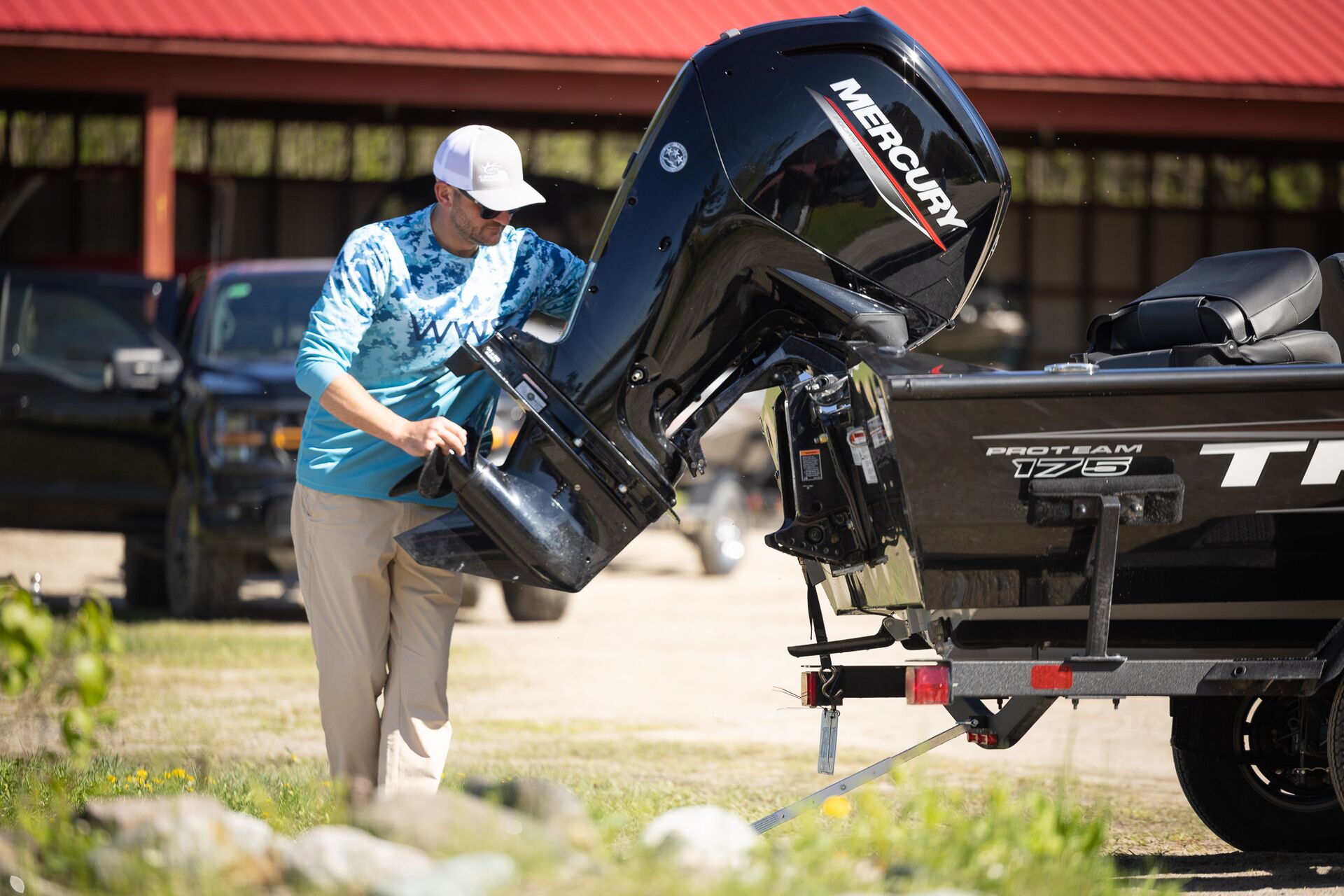
Pull the boat and do a final walk-around. Check the bilge for water. A little splash from waves is normal, but if you've got a steady trickle, you've got a leak. Check the lower unit for oil weeping at the seals. If you see a milky sheen or drips, the seals are compromised and water is getting into the gear oil.
Look at the engine mounts. If they're cracked or sagging, they'll let the engine vibrate loose. We've seen bolts back out and engines shift on the transom because worn mounts weren't replaced.
When to Call a Professional

If your shakedown reveals a problem you can't fix—bad compression, a seized lower unit, or electrical gremlins—don't limp through the season. Bring it to a certified shop. We're ABYC certified and see this stuff daily. A small fix in April is cheaper than a full teardown in July when you're stuck halfway through vacation. For guidance on when to seek help, check When to Seek Professional Help vs DIY Fix.
Parts: OEM vs. Aftermarket

OEM parts are reliable, but you're paying for the logo. A factory water pump kit might run $120 when an aftermarket equivalent is $45. The cheap kits from random sellers are garbage—wrong rubber durometer, poor fitment, and you'll be pulling the lower unit again in three months.
This is why we run JLM Marine kits. You get factory-spec tolerances and materials without the dealership markup. The impellers fit right, the seals don't weep, and the housings match OEM dimensions. We ship direct from the factory worldwide, so a guy in Australia gets the same quality as someone in Florida.
Not all non-OEM parts are junk. Some of the same factories that produce OEM components use excess capacity to manufacture non-OEM lines. JLM Marine sources from those facilities, so you're getting the same quality control at a lower price point. For a deeper dive, see our post on OEM vs. Aftermarket Outboard Parts: What’s the Difference?.
Sea Tow and Breakdown Coverage
Even if you do everything right, stuff breaks. A fouled prop, a dead battery, or a fuel line that splits underway—it happens. That's why we recommend Sea Tow or BoatUS membership. For about $150 a year, you get unlimited towing, jump-starts, fuel drops, and soft ungroundings.
Sea Tow operates through local franchises, so response time is usually under an hour in most coastal areas. Call 1-800-4SEATOW if you need a tow. BoatUS offers similar coverage and adds some freshwater-focused services if you're on lakes or rivers.
Don't skip this. A single tow can cost $500–$1,200 depending on distance. The membership pays for itself the first time you need it.
After every shakedown or regular run, flush your engine with fresh water for ten minutes using a flush adapter on the lower unit. It clears salt, silt, and debris from the cooling passages and keeps the thermostat from seizing. Do it every time, and your cooling system will outlast the boat. For details on thermostat maintenance, see Thermostat Maintenance: Keeping Your Outboard Running Cool.
Discover more parts and resources on our main JLM Marine website.
Hi—I’m Jim Walker
I grew up in a Florida boatyard, earning pocket money (and a few scars) by rebuilding outboard carbs before I could drive. That hands-on habit carried me through a Ph.D. in mechanical engineering, where I studied how salt water quietly murders metal.
I spent ten years designing cooling systems for high-horsepower outboards, then joined JLM Marine as CTO. We bench-test every new part in the lab, but I still bolt early prototypes onto my own 23-foot skiff for a weekend shake-down— nothing beats real wake and spray for finding weak spots.
Here on the blog I share the fixes and shortcuts I’ve learned so your engine—and your day on the water—run smooth.

For Boat Owners:
To assist you in maintaining and repairing your marine engines, we hope the following resources may be of use:
- Mercury Serial Number Guide
- Owner's Manuals from Mercury
- Official Model Number Reference Guide PDF from BRP
- Johnson Serial Number Guide
-
Boat Accessories from JLM Marine
About JLM Marine
Founded in 2002, JLM Marine has established itself as a dedicated manufacturer of high-quality marine parts, based in China. Our commitment to excellence in manufacturing has earned us the trust of top marine brands globally.
As a direct supplier, we bypass intermediaries, which allows us to offer competitive prices without compromising on quality. This approach not only supports cost-efficiency but also ensures that our customers receive the best value directly from the source.
We are excited to expand our reach through retail channels, bringing our expertise and commitment to quality directly to boat owners and enthusiasts worldwide.
Boat Accessories on Sale
- $37.99
$45.99- $37.99
- Unit price
- per
- $34.99
- $34.99
- Unit price
- per
- $128.99
- $128.99
- Unit price
- per

- $25.30
$30.00- $25.30
- Unit price
- per


- $34.99
$41.99- $34.99
- Unit price
- per

- $32.50
$31.00- $32.50
- Unit price
- per

- $139.99
- $139.99
- Unit price
- per


- $45.00
- $45.00
- Unit price
- per
-
Red
-
Blue

- $28.50
$29.00- $28.50
- Unit price
- per

- $159.99
- $159.99
- Unit price
- per


- $105.00
- $105.00
- Unit price
- per


- $34.99
$41.99- $34.99
- Unit price
- per


- From $68.00
- From $68.00
- Unit price
- per
-
Silver
-
Blue
-
Red


- $34.99
$41.99- $34.99
- Unit price
- per

- $59.95
$71.00- $59.95
- Unit price
- per

- $59.99
$71.00- $59.99
- Unit price
- per


- $34.99
$41.99- $34.99
- Unit price
- per

- $65.50
$78.00- $65.50
- Unit price
- per

- $67.00
$65.00- $67.00
- Unit price
- per

- $19.99
- $19.99
- Unit price
- per