


Fuel Stabilization in Fall: Keeping Gas Fresh Over Winter
- Why Gas Degrades During Winter Storage
- How Fuel Stabilizers Work
- Pre-Check: Is Your Current Fuel Already Bad?
- Step-by-Step: Stabilizing Fuel for Winter
- Storage Protocol for Small Engines
- Strategies for Storage Longer Than 12 Months
- Storing Fuel in Containers
- What to Expect When You Start Up in Spring
- FAQ
After 20 years working on outboards and small engines, I can tell you the biggest mistake people make every fall is skipping fuel stabilization. Come spring, half the engines we see won't start because of varnished carburetors and corroded fuel systems.
Why Gas Degrades During Winter Storage
Gasoline starts breaking down the moment you pump it. According to the Alternative Fuels Data Center, untreated gas begins oxidizing within 30 days, creating varnish and gum deposits that clog jets, fuel lines, and injectors. The more air in your tank, the faster it happens.
Ethanol makes it worse. Most pump gas in the US contains E10 (10% ethanol), and ethanol is hygroscopic—it pulls moisture straight out of the air. That water doesn't just sit there. It separates from the gasoline in a process called phase separation, settling to the bottom of your tank where it causes rust, corrosion, and fuel system damage. We've torn apart fuel pumps that looked like they'd been sitting in saltwater for a year when they'd only been through one bad winter with untreated E10.
The symptoms are predictable: rough idle, hesitation under throttle, or the engine won't fire at all. Sometimes you'll see a dark, varnish smell when you crack open the tank. By that point, you're looking at carburetor rebuilds or injector cleaning —all preventable.
How Fuel Stabilizers Work
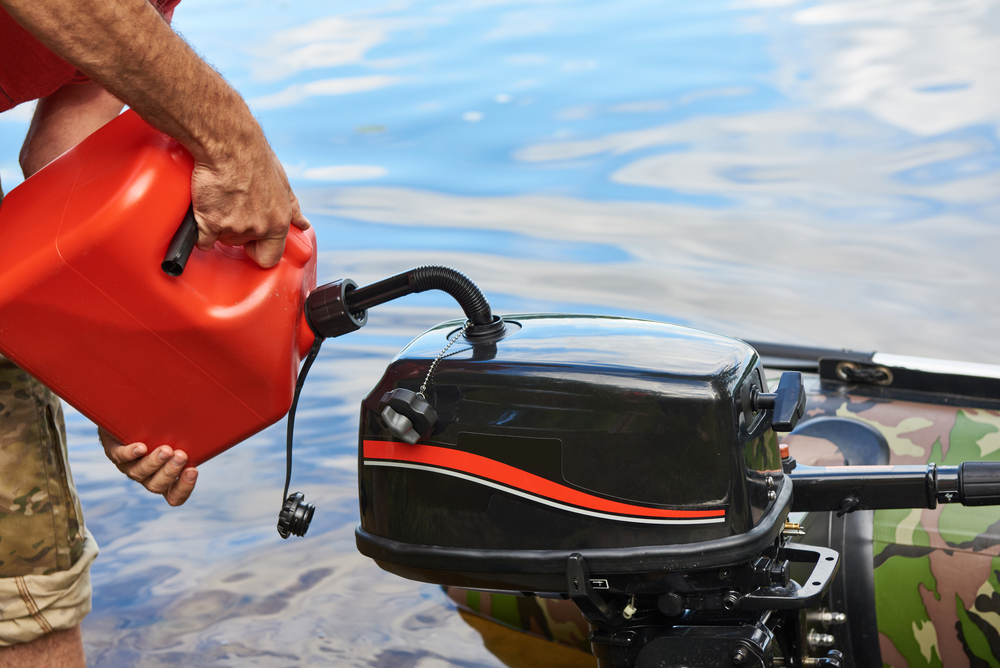
A good stabilizer does two things: it stops oxidation and protects against ethanol-related damage. Products like STA-BIL Storage, Sea Foam, and PRI-G contain petroleum distillates and antioxidants that coat fuel molecules and slow chemical breakdown. According to Briggs & Stratton, properly stabilized fuel can last 12 to 24 months instead of the usual 30 to 90 days.
The corrosion inhibitors in stabilizers also create a protective film inside your fuel system. We've seen boats stored in Michigan with STA-BIL-treated fuel sit from October through April and fire up on the first turn of the key. Compare that to untreated tanks—those come in with gummed-up needle valves and pitted float bowls. If you do end up with deposits, check our carburetor repair kits for OEM-quality parts to restore your engine.
Pre-Check: Is Your Current Fuel Already Bad?
Before you add stabilizer, check if the gas in your tank is already too far gone. Pull the fuel cap and smell it. Good gas has a sharp, clean petroleum smell. If it smells sour, like varnish or old paint, it's degraded. Look at the color too—gas should be clear to pale yellow. If it's dark amber or has visible particles floating in it, drain the tank completely before starting over with fresh fuel and stabilizer.
Stabilizer can't fix fuel that's already separated or oxidized. You're just preserving junk at that point.
Step-by-Step: Stabilizing Fuel for Winter
Step 1: Calculate and Add the Correct Dosage
Read the label on your stabilizer bottle. Treatment ratios vary—STA-BIL is typically 1 oz per 2.5 gallons, Sea Foam is 1 oz per 2 gallons, and PRI-G is 1 oz per 10 gallons. Here's the important part: calculate the dose based on the total volume you'll have after filling the tank, not just what's in there now.
Example: if your tank holds 6 gallons and you've got 1 gallon left, you're adding 5 gallons of fresh gas for a total of 6. Dose for 6 gallons, not 1.
Pour the stabilizer directly into the tank before you fill up. Adding it to an empty or near-empty tank ensures it mixes thoroughly when you add the fresh fuel.
Step 2: Fill the Tank with Fresh Gasoline
After adding stabilizer, fill your tank all the way to the top with fresh gasoline. This does two critical things: it mixes the stabilizer evenly through the entire fuel volume, and it minimizes the air space in the tank. Less air means less oxidation and less room for moisture to condense during temperature swings.
Best practice: if you can get ethanol-free gas (often labeled as "recreational fuel" or "marine gas" at the pump), use that. Ethanol-free fuel lasts longer in storage because it doesn't attract water or phase-separate. You'll still want to add stabilizer even with ethanol-free, but you're starting from a better baseline. Most marinas and some rural gas stations carry it—check Pure-Gas.org for locations near you.
Step 3: Circulate Stabilized Fuel Through the System
Don't just top off the tank and walk away. Start the engine and let it run until it reaches normal operating temperature—usually 5 to 10 minutes depending on the engine. You'll know it's ready when the idle smooths out and settles into its normal rhythm.
This step pushes treated fuel through the entire fuel system: the lines, the fuel pump, the filter, the carburetor bowls or injector rails. Every internal surface gets coated with stabilizer. If you skip this, the untreated fuel sitting in your carburetor will still gum up over the winter, and you'll be tearing it apart in the spring anyway. To learn more about the carburetor system and needle valves, see our section on Outboard Engine Fuel Bowl Not Filling? Troubleshooting Your Carburetor's Float & Needle Valve.
For carbureted engines, make sure the engine idles long enough that fuel cycles through the float bowl at least twice. On a small outboard, that's about 10 minutes at a steady idle.
Storage Protocol for Small Engines
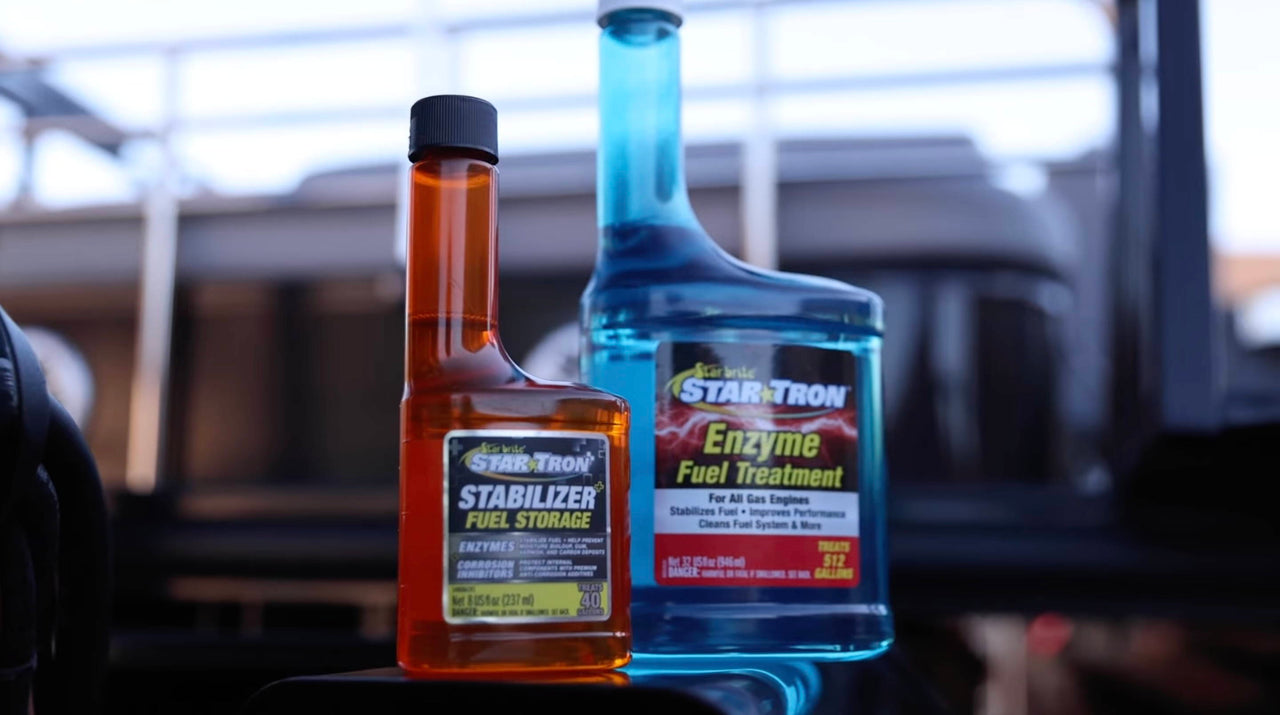
Lawnmowers, chainsaws, snowblowers, generators—same rules apply. Add stabilizer, fill the tank with fresh gas, and run the engine until it reaches operating temp.
2-stroke vs. 4-stroke difference: If you run pre-mixed fuel (gas and 2-stroke oil already combined), you can still add stabilizer. Use a stabilizer compatible with 2-stroke fuel, like Sea Foam Motor Treatment. Add it to the pre-mix container before you fill the tank, then run the engine to circulate it.
For 4-stroke engines (most mowers and generators), just follow the three steps above. We've had customers in Wisconsin report that chainsaws and mowers treated with Sea Foam in late fall started on the first pull the following spring—no carburetor cleaning required.
Strategies for Storage Longer Than 12 Months

Stabilizers extend fuel life to 12–24 months, but beyond that you're in long-term storage territory. If you're storing a vehicle or equipment for more than a year, you've got two options:
Option 1: Drain it completely. Pull all the fuel out of the tank and run the engine until it dies to empty the fuel system. This is the safest route for storage beyond two years, especially for carbureted engines. No fuel means nothing to go bad.
Option 2: The annual refresh. If you want to keep fuel in the system, run the engine once a year, let it reach operating temperature, then top off the tank with fresh fuel and a new dose of stabilizer. This keeps everything lubricated and prevents seals from drying out.
Dry vs. wet carburetor storage: There's debate here. Some mechanics drain the carburetor bowl completely to prevent varnish buildup ("dry storage"). Others leave the bowl full of stabilized fuel to keep internal gaskets from cracking ("wet storage"). For storage under 12 months, wet is fine—just make sure that fuel is treated. For longer periods, drain the bowl and spray a light coating of fogging oil into the carburetor throat before you close it up. To learn more about fogging, see our Fogging Your Engine for Winter: Why and How guide.
Storing Fuel in Containers
If you've got leftover stabilized gas in a jerry can or storage jug, that's fine for short-term backup. But here's the thing: even in a sealed container, fuel degrades faster than it does in a vehicle's tank. Air gets in every time you open the cap, and cheaper plastic containers aren't truly airtight.
Use your stored fuel in your daily driver or regular-use equipment within a few months. Don't let it sit in the can all winter and then try to run it in your mower next spring. Pour it into your truck's tank (where it'll get diluted and burned off) and start over with fresh, stabilized fuel when you need it.
Store containers in a cool, dry location away from direct sunlight. Heat accelerates fuel breakdown.
What to Expect When You Start Up in Spring
If you followed the steps—stabilizer added, tank filled, engine run to circulate—your engine should start normally when the weather warms up. You won't see varnish in the carburetor, no corrosion in the tank, and the fuel will still smell clean.
If you skipped stabilization, expect hard starting, rough running, or no start at all. You might notice the engine sputters and dies under load, or idles rough and wonps to clear out. At that point, you're draining the tank, cleaning or rebuilding the carburetor, and possibly replacing fuel lines and fuel filters. A $12 bottle of stabilizer in October saves a $200 repair bill in April.
FAQ
How long can gasoline last in storage without going bad?
Untreated gas degrades in 30 days. With stabilizer, it lasts 12–24 months depending on the product and storage conditions.
What happens if I don't use fuel stabilizer during winter storage?
The gas oxidizes, forming varnish and gum that clog fuel system components. Ethanol absorbs water, leading to phase separation and corrosion. You'll likely face hard starting or complete failure in spring.
Will ethanol-free gasoline last longer in storage?
Yes. Ethanol-free fuel doesn't attract moisture or phase-separate, so it degrades slower. But it still oxidizes, so add stabilizer for any storage longer than a month.
Can I use old gasoline after winter storage?
If it wasn't stabilized, don't risk it. Old fuel causes rough running, hesitation, and potential damage to injectors or carburetor jets. Drain it and start with fresh gas.
What are the symptoms of bad gas in my engine after storage?
Difficulty starting, rough idle, sputtering under throttle, loss of power, or the engine won't run at all. You might see dark or cloudy fuel, smell varnish, or find rust in the tank.
About JLM Marine
We manufacture and supply high-quality marine parts directly from the factory to customers worldwide. Our team includes ASE-certified mechanics with decades of hands-on experience in outboard repair and maintenance. For all your marine parts needs, trust JLM Marine for quality and service.
Keep a spare bottle of stabilizer in your garage year-round so you're never caught off-guard when it's time to store an engine. For more guides on maintaining your outboard engine, visit the JLM Marine homepage.
Hi—I’m Jim Walker
I grew up in a Florida boatyard, earning pocket money (and a few scars) by rebuilding outboard carbs before I could drive. That hands-on habit carried me through a Ph.D. in mechanical engineering, where I studied how salt water quietly murders metal.
I spent ten years designing cooling systems for high-horsepower outboards, then joined JLM Marine as CTO. We bench-test every new part in the lab, but I still bolt early prototypes onto my own 23-foot skiff for a weekend shake-down— nothing beats real wake and spray for finding weak spots.
Here on the blog I share the fixes and shortcuts I’ve learned so your engine—and your day on the water—run smooth.

For Outboard Owners:
To assist you in maintaining and repairing your marine engines, we hope the following resources may be of use:
-
Fuel Pumps from JLM Marine
-
Fuel Pump Kits from JLM Marine
About JLM Marine
Founded in 2002, JLM Marine has established itself as a dedicated manufacturer of high-quality marine parts, based in China. Our commitment to excellence in manufacturing has earned us the trust of top marine brands globally.
As a direct supplier, we bypass intermediaries, which allows us to offer competitive prices without compromising on quality. This approach not only supports cost-efficiency but also ensures that our customers receive the best value directly from the source.
We are excited to expand our reach through retail channels, bringing our expertise and commitment to quality directly to boat owners and enthusiasts worldwide.
Fuel Pump on Sale
- $73.50
$88.00- $73.50
- Unit price
- per
- $16.00
- $16.00
- Unit price
- per
- $17.99
$21.00- $17.99
- Unit price
- per

- $18.99
- $18.99
- Unit price
- per

- $21.99
- $21.99
- Unit price
- per

- $45.99
$55.00- $45.99
- Unit price
- per

- $23.59
$28.00- $23.59
- Unit price
- per

- $28.99
$34.00- $28.99
- Unit price
- per

- $21.99
- $21.99
- Unit price
- per
- $46.50
$60.00- $46.50
- Unit price
- per
- $26.80
- $26.80
- Unit price
- per
- $24.80
- $24.80
- Unit price
- per
- $28.90
- $28.90
- Unit price
- per

- $27.77
- $27.77
- Unit price
- per

- $56.99
- $56.99
- Unit price
- per

- $129.95
$155.00- $129.95
- Unit price
- per

- $31.20
$37.00- $31.20
- Unit price
- per

- $129.95
$155.00- $129.95
- Unit price
- per
- $138.00
- $138.00
- Unit price
- per
- $24.80
$45.00- $24.80
- Unit price
- per