

Prop Pitch and Diameter: How They Affect Speed & Power
- Understanding Propeller Diameter
- Understanding Propeller Pitch
- How to Select the Right Diameter and Pitch
- How Blade Count and Material Affect Pitch Selection
- Reading Your Propeller Stamps
- Additional Variables That Affect Prop Performance
- Pitch-to-Diameter Ratio
- Troubleshooting: Ventilation vs Cavitation
- Spun Hub: The Hidden Problem
- Pre-Contact Checklist
- Glossary
- OEM vs Aftermarket Props
If your outboard isn't hitting its RPM range or your boat won't get on plane, start with the propeller. After two decades wrenching on outboards, I can tell you most performance problems trace back to the wrong prop specs. Propeller diameter and propeller pitch control how your engine loads up and how your boat moves through water.
Understanding Propeller Diameter
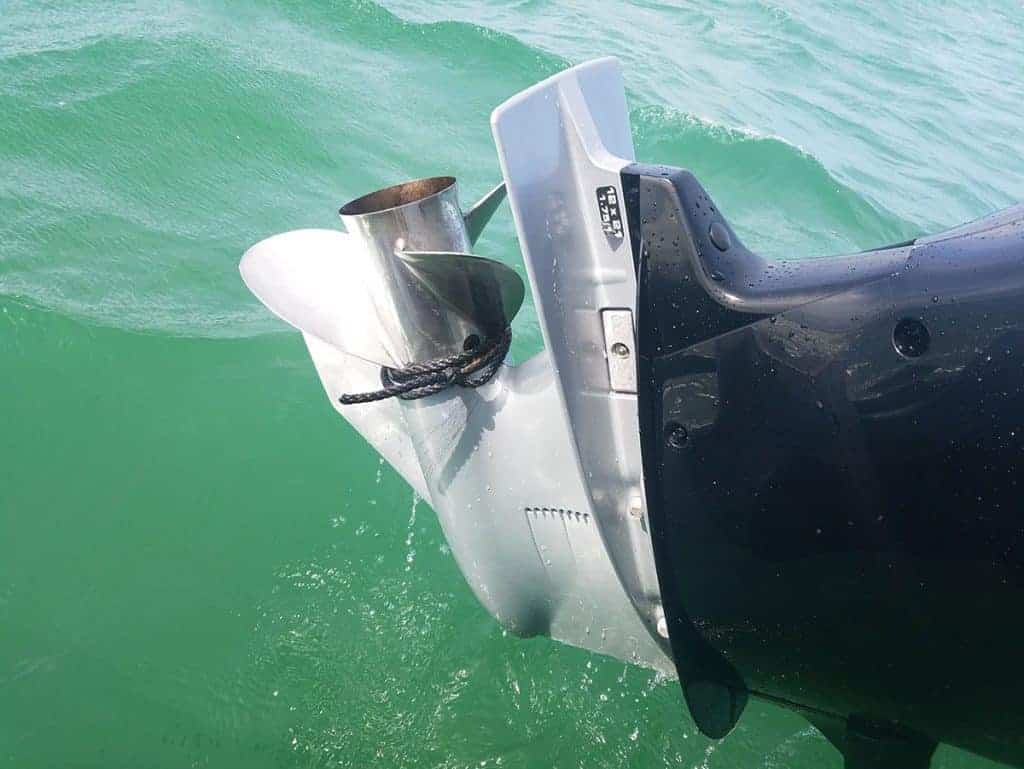
Diameter is the circle your prop blade tips trace when spinning. A 16-inch diameter prop sweeps a 16-inch circle. That's it.
How Diameter Affects Thrust and Engine Load
Larger diameter means more blade area in the water. More area moves more water per revolution, generating more thrust. If you're running a heavy pontoon or pulling tubes, that extra thrust gets you on plane and holds speed under load.
The trade-off: more resistance on the engine. A larger diameter prop drops your wide-open throttle (WOT) RPM. Put too much diameter on your motor and you'll lug the engine—it sounds strained, runs below its designed RPM range, and you're asking for premature wear or failure.
Smaller diameter props spin easier, let the engine rev higher, and reduce drag at speed. On a lightweight bass boat or flats skiff, you want minimal diameter to let that motor wind up.
Diameter Selection by Boat Type
Match diameter to your hull and use:
-
Heavy boats, pontoons, towing rigs: Larger diameter (MerCruiser Bravo Two drives can run up to 20-inch diameter). You need the thrust.
-
Lightweight performance boats, high-speed applications: Smaller diameter (typically 14-16 inches for outboards). You're chasing RPM and top speed, not pulling power.
We've seen customers try to fix acceleration issues by adding horsepower when they just needed a prop with the right diameter for their load. Save your money and spec the prop first. For more insights on boat performance, check out our detailed Proper Propeller Selection for Better Fuel Economy article.
Understanding Propeller Pitch

Pitch is the theoretical distance your prop advances forward in one full revolution through solid water—no slippage. A 21-inch pitch prop should move 21 inches forward per turn. In reality, propeller slip (the difference between theoretical and actual distance) runs 10-20%, but pitch still dictates your speed potential.
Higher pitch = more distance per revolution = higher top speed, assuming your engine has the power to spin it.
Lower pitch = less distance per revolution = quicker acceleration and better hole-shot.
Pitch and Engine RPM: The 150-200 Rule
This is the most important rule of thumb you'll use: every 1-inch change in pitch shifts your WOT RPM by 150-200.
Example: Your Yamaha 150 is turning 5,800 RPM at WOT with a 19-inch pitch prop, but the manual says max RPM is 5,500. You're over-revving. Swap to a 21-inch pitch prop and you'll drop roughly 300-400 RPM, landing you right in spec.
That relationship is consistent whether you're running a 25-horse or a 300-horse. Mercury Marine and BoatTEST testing confirms this across their prop lines.
Symptoms of Incorrect Pitch
Pitch too high: Engine lugs, struggles to reach rated WOT RPM, sounds like it's laboring under load. You're leaving power on the table and stressing internal components.
Pitch too low: Engine hits the RPM limiter before the boat reaches potential top speed. You'll have great acceleration off the line, but you're done gaining speed while the motor screams.
Balancing Pitch for Acceleration vs Top Speed
If your priority is hole-shot—getting a skier out of the water, pulling a loaded boat onto plane quickly—drop pitch. Going from a 23-inch to a 21-inch pitch prop will typically boost your WOT RPM by 300-400, giving you immediate torque and pull. We've sent props to customers running pontoons who dropped 2 inches of pitch and finally got their boats to plane with a full load.
If you want top speed and run on calmer water, increase pitch. A test on a 30'6" Marvel 930 RIB with a 300-hp Suzuki showed that moving from an 18.5-inch to a 21.5-inch pitch prop increased cruise speed at 4,000 RPM from 26 knots to 30 knots. The cost? Slower acceleration and longer time to plane.
You can't have both maximum acceleration and maximum top speed on the same prop. Pick your priority.
For more detailed comparisons on prop pitches, you can also read our blog on Comparing Propeller Pitches: Finding the Best Pitch for Your Boat.
How to Select the Right Diameter and Pitch
Check Your Engine's WOT RPM Range
Every outboard has a specified WOT RPM range stamped in the owner's manual. For most engines it's somewhere between 5,000-6,000 RPM, but check your specific model. Your goal is to hit the upper end of that range with a typical load (normal fuel, gear, passengers) on calm water.
If you're below the range, you need less pitch or diameter. If you're above, you need more.
Field Testing Your Prop
You have to test on the water. No calculator replaces real data from your boat.
-
Load the boat normally: typical fuel level, your usual gear and passengers.
-
Run at WOT in calm water: Trim the engine to its optimal running angle (usually trimmed out until the bow starts to rise, then back it off slightly).
-
Record your max RPM: Use a quality tachometer or your engine's gauge.
-
Have a spotter: Don't try to read the tach while running WOT solo. Keep your eyes forward.
-
Compare to spec: Check your manual's WOT range.
If you're 200 RPM low, drop 1 inch of pitch. If you're 400 RPM high, add 2 inches.
We had a guy in Australia running a repowered hull. He emailed us his engine specs and current WOT reading. His motor was lugging at 4,800 RPM with a 23-inch prop when it should've been hitting 5,500. We matched him with a 21-inch pitch and he landed at 5,400 RPM—right in the sweet spot.
Using Expert Support
When you contact us at JLM Marine, have this info ready:
-
Engine make, model, and serial number (stamped on the transom bracket or mounting plate)
-
Current propeller size (stamped on the prop barrel or between the blades, usually formatted as diameter x pitch, like "14.5 x 19")
-
Your current WOT RPM
-
Boat weight and typical use (cruising, towing, fishing, etc.)
That's enough for us to guide you to the right spec. We stock props from reputable manufacturers and source direct from factories that produce OEM-equivalent parts. You're getting factory-spec fitment without the dealership markup. For a comprehensive range of parts direct from the factory, explore our JLM Marine main site.
How Blade Count and Material Affect Pitch Selection
Three-Blade vs Four-Blade Props
Blade count changes how the prop loads your engine. A four-blade prop typically acts like a three-blade with about 1 inch more pitch regarding engine load and RPM.
If you're switching from a three-blade to a four-blade and want to maintain the same WOT RPM, drop the pitch by 1 inch. The extra blade provides smoother power delivery, better grip in rough water, and improved hole-shot, but it also increases drag.
Four-blade props are common on boats that:
-
Tow heavy loads
-
Run in choppy conditions
-
Need better low-speed handling
-
Have trouble getting on plane
Aluminum vs Stainless Steel
Material stiffness matters more than most people realize.
Aluminum props flex under load. That flex effectively reduces the pitch as the blades bend back under thrust. An aluminum 21-inch prop might perform closer to a 20-inch under hard acceleration because the blades can't hold their shape.
Stainless steel props are rigid. They hold their designed pitch under load, delivering more consistent thrust and better top-end efficiency. Stainless is also thinner, which reduces drag and typically adds 2-3 mph over an equivalent aluminum prop.
The downside? Stainless costs more and won't sacrifice itself if you hit something—it'll transfer that impact straight to your lower unit.
For most recreational applications, aluminum is fine. For performance or heavy-duty use, stainless is worth the investment. Learn more about material choices in our post on Stainless Steel vs. Aluminum Propellers: Which Is Better?.
Reading Your Propeller Stamps

Before you call or email anyone about a new prop, walk out to your boat and check what you currently have.
Prop size is stamped on the prop itself, usually in one of three places:
-
On the barrel (center hub)
-
Between the blades on the hub
-
On the inside face of the hub
The format is almost always diameter x pitch, like "15 x 19" (15-inch diameter, 19-inch pitch). Some manufacturers add a model number or material code, but the two numbers you need are diameter and pitch.
If the stamp is corroded or you're not sure what you're looking at, take a photo and send it to us. We'll decode it for you. For help identifying engine serial numbers and parts, check our Yamaha Outboard Serial Number Guide or Mercury Serial Number Guide.
Additional Variables That Affect Prop Performance

Propeller Cup
Cup is a small curl on the trailing edge of the blade. It acts like extra pitch—typically adding the equivalent of 1 inch—without changing the actual pitch measurement.
A cupped 19-inch prop will load the engine closer to a 20-inch. Cup also helps the prop hold water better, reducing ventilation (when the prop sucks air from the surface) and improving grip in tight turns or rough conditions.
If you're running a performance boat or operating at high altitudes (more on that below), cup can make a significant difference.
High Altitude Adjustments
Engines lose about 3% of their power for every 1,000 feet of elevation above sea level. If you're running a boat on a mountain lake at 5,000 feet, your engine is making roughly 15% less horsepower than at sea level.
That means you need to drop pitch to let the engine reach its rated WOT RPM. A boat propped perfectly at sea level will lug badly at altitude. Drop 2-3 inches of pitch for high-altitude lakes and retest.
Repowering an Older Boat
If you've bolted a new, more powerful engine onto an old hull, throw out any assumptions about your old prop. The previous engine's prop was sized for different horsepower and torque.
Start by checking the new engine manufacturer's recommendations for your hull type and weight. Test conservatively with a mid-range pitch, check your WOT RPM, and adjust from there. Don't assume the prop that came with your old 90-horse will work on your new 150.
Engine Mounting Height
How high or low your engine sits on the transom affects prop performance. Raise the engine and you reduce drag but risk ventilation. Lower it and you increase grip but add drag.
If you've adjusted your engine height, retest your WOT RPM. What worked at one height may not work at another.
Boat Weight and Load Distribution
Every 100 pounds you add to your boat shifts performance. A half-tank of fuel, an extra cooler, a third passenger—it all adds up.
Prop selection should be based on your typical heavy load, not your lightest configuration. If you usually run with four people and a full tank, test with that load. Don't prop for solo trips and then wonder why your engine lugs with passengers aboard.
For insights on how weight affects boat performance, see our article on Lightening the Load: How Boat Weight Affects Fuel Use.
Pitch-to-Diameter Ratio

The optimal pitch-to-diameter ratio generally falls between 0.8 and 1.8. This ratio helps balance efficiency and thrust, but it's a guideline, not a hard rule.
Example:
-
14-inch diameter x 21-inch pitch = 1.5 ratio (common for mid-range outboards)
-
16-inch diameter x 19-inch pitch = 1.19 ratio (common for larger, slower boats needing thrust)
If you're outside this range, you might be sacrificing efficiency or loading your engine unevenly, but the real test is always WOT RPM in your manufacturer's spec range.
Troubleshooting: Ventilation vs Cavitation
People confuse these two, but they're different problems.
Ventilation: The prop pulls air from the surface (or from exhaust) down into the blades. You'll feel a sudden RPM spike and loss of thrust, usually in tight turns or when the bow lifts too high. Fix it by lowering the engine, adding cup to the prop, or adjusting trim.
Cavitation: Vapor bubbles form on the blade surface due to low pressure, then collapse, causing pitting and blade damage. It sounds like the prop is running through gravel. Causes include a damaged prop (bent blade, nicked edge), incorrect diameter, or running the engine too high on the transom.
Diameter directly impacts both. Too small and you risk ventilation. Damaged blades cavitate regardless of size. To learn more about this, visit our post on Cavitation vs Ventilation: Why Your Prop Isn’t Gripping Water.
Spun Hub: The Hidden Problem
If your boat suddenly lost speed and your engine revs freely but the boat barely moves, you likely spun the hub. The rubber hub inside the prop (designed to protect your lower unit from impact damage) has sheared and is slipping on the prop shaft.
It feels like a pitch issue—high RPM, low speed—but it's mechanical damage. Pull the prop and inspect the hub. If the rubber is chewed up or loose, replace the hub or the entire prop. No amount of pitch adjustment will fix a spun hub.
Pre-Contact Checklist
Before you email or call for prop advice, gather this information:
-
Engine serial number: Found on the transom bracket or mounting plate
-
Current prop size: Diameter x pitch, stamped on the prop
-
Current WOT RPM: Tested with typical load on calm water
-
Boat weight: Dry weight plus typical fuel and gear
-
Primary use: Cruising, towing, fishing, racing, etc.
-
Any recent changes: Repowered, added weight, changed mounting height
That's enough to get you an accurate recommendation without guessing. For support and to browse quality boat parts, visit the JLM Marine boat parts collection.
Glossary
WOT (Wide-Open Throttle): Maximum throttle position; the highest RPM your engine reaches under load.
Hole-shot: Initial acceleration from a standstill onto plane.
Planing: When the boat rises and skims on top of the water rather than pushing through it.
Slip: The difference between the theoretical distance a prop should advance (pitch) and the actual distance traveled, typically 10-20%.
Rake: The angle of the blade relative to the hub; high rake lifts the bow.
Cup: A small curl on the trailing edge of the blade that improves grip and acts like added pitch.
Ventilation: Propeller pulls air from the surface into the blades, causing RPM spike and thrust loss.
Cavitation: Vapor bubbles form and collapse on the blade surface, causing damage and noise.
OEM vs Aftermarket Props
Let's be direct: OEM props are good quality, but you're paying a premium for the logo. A factory Yamaha or Mercury prop works, but it costs 30-50% more than equivalent aftermarket options.
Cheap aftermarket props from random sellers are junk. The aluminum is softer, the tolerances are off, and they won't hold up. You'll be pulling your lower unit again in a season.
The middle ground—reputable aftermarket manufacturers like those we source from at JLM Marine—gives you factory-spec quality without the dealer markup. Many of these factories produce OEM parts under contract and use excess capacity to manufacture non-OEM equivalents. The specs, materials, and fitment are the same. We've shipped these props worldwide, and they perform identically to OEM at a fraction of the cost.
If you want to burn money on a sticker, buy OEM. If you want the same performance and keep cash in your pocket, buy smart aftermarket.
Pro tip: After every ride, especially in salt water, flush your engine with fresh water for at least 10 minutes using muffs or a flushing port. This prevents salt buildup in the cooling passages and keeps your water pump impeller from seizing. Your prop won't matter if your engine overheats and grenades itself.
Sources: