


Fueling Safety: 10 Tips to Refuel Without Spills
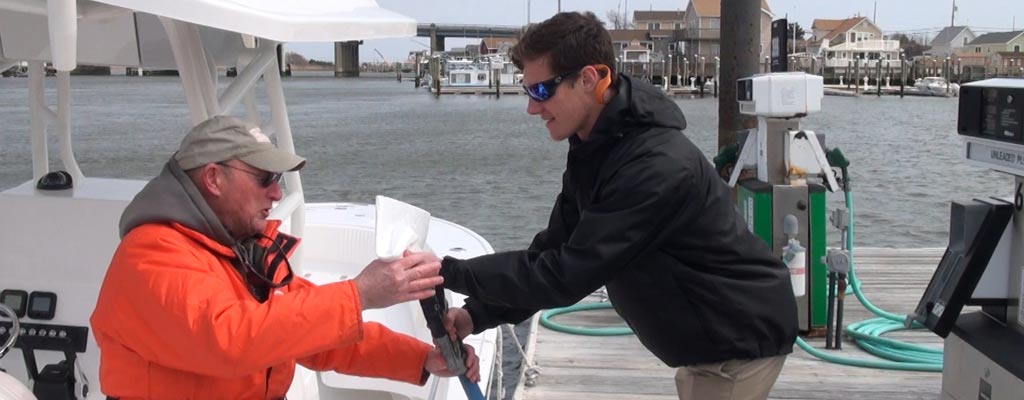
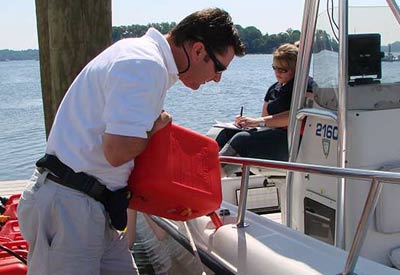
After 20 years wrenching on outboards, I've seen what happens when people get careless at the fuel dock. Melted gelcoat from spilled gas, bilges full of fumes that nearly turned into fireballs, and more than a few engines that needed fuel system overhauls because somebody couldn't be bothered to follow basic safety steps. This stuff matters.
You're here because you want to refuel without making a mess or blowing yourself up. Good. Here's what actually works.
Why You Need to Pay Attention When Fueling
Gasoline fumes are heavier than air and will travel along the deck or ground to find an ignition source. We've had boats come into the shop where the bilge was so saturated with fumes that one spark from the starter solenoid could've turned the whole thing into kindling. According to the National Fire Protection Association, fuel vapors ignite at concentrations as low as 1.4% in air—you won't even smell it at dangerous levels sometimes.
Diesel's less volatile, but spill enough of it and you're looking at environmental fines that'll make your eyes water. The Coast Guard doesn't care if it was an accident.
The 10 Rules
1. Engine Off, Keys Out
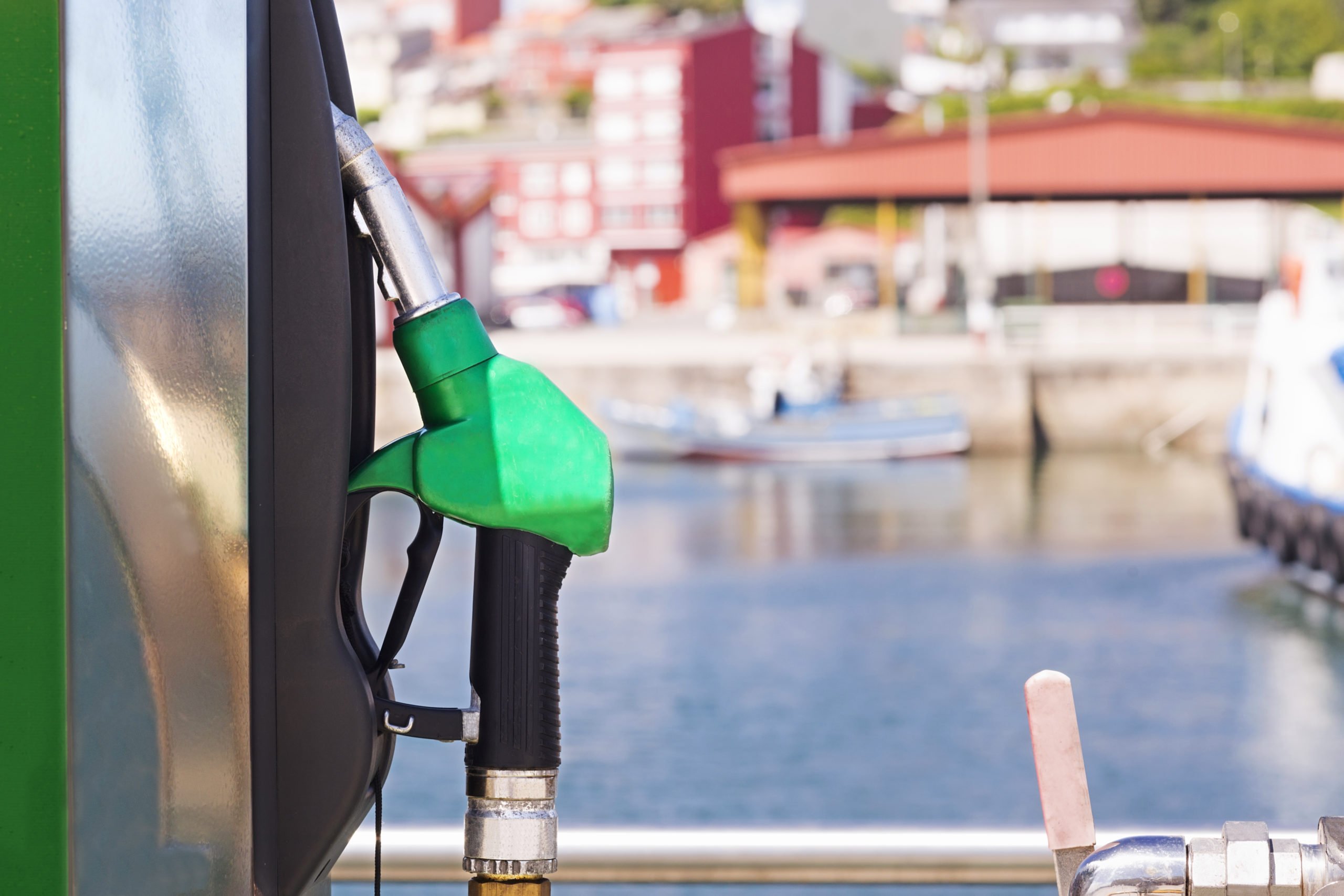
Turn the engine completely off and pull the keys before you touch the fuel cap. Not just "off"—I mean keys in your pocket. A hot engine block, a misfiring spark plug, or even residual heat in the exhaust can ignite vapors. This is the single most important step according to OSHA's flammable liquids standard 1910.106.
On inboard boats, run your bilge blower for a full four minutes after fueling before you hit the starter. Fumes settle in the bilge, and that's where the explosion happens. To help maintain your engine in top shape for safe operation, check out our comprehensive Inboard & Outboard Motor Parts collection to find reliable components.
2. Ground Yourself Before You Touch the Nozzle
Static electricity builds up on your body, especially if you're wearing synthetic fabrics like polyester or nylon. Before you grab the fuel nozzle, touch a bare metal part of your vehicle or boat—the gunwale, the fill neck housing, anything unpainted. This discharges the static. We've seen flash fires start from a static spark you couldn't even see. The Petroleum Equipment Institute has documented dozens of these incidents.
If you're filling a portable container, set it on the ground first. Never fill a gas can sitting in your truck bed or on your boat deck—the plastic or fiberglass insulates it, and static builds up with no path to ground.
3. Keep the Nozzle in Contact With the Fill
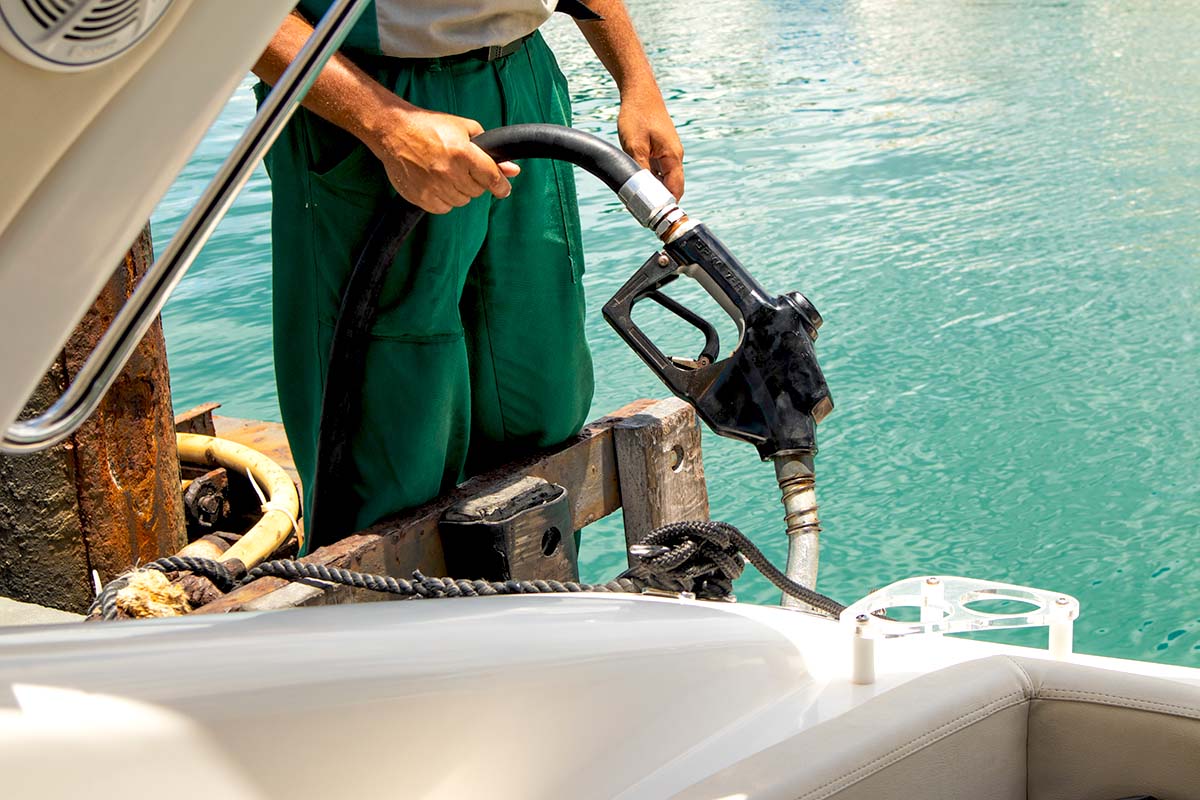
Once you start fueling, keep the metal nozzle pressed firmly against the metal fill neck. This maintains electrical contact and prevents static from building between the nozzle and your tank. Don't let it rattle around or hold it away from the opening. The Maryland Department of the Environment's fueling guidelines specifically call this out as a critical step.
4. Stop When the Nozzle Clicks
When the automatic shut-off clicks, you're done. Do not squeeze the trigger again to "top it off." Your tank is designed to be filled to about 95% capacity to leave room for fuel expansion when it heats up. If you force more fuel in, you're pushing liquid fuel up into the evaporative emissions system.
Here's what happens: modern engines use a charcoal canister to capture fuel vapors. When you overfill, liquid gasoline floods this canister, saturating the charcoal. The canister is designed for vapor, not liquid. Once it's saturated, it stops working, your check engine light comes on, and you're looking at a $200-400 replacement. I've done this job more times than I can count, and it's always because somebody topped off the tank. For advice on managing fuel correctly and replacing parts when needed, see our Fuel Pump and Fuel Filter collections.
5. Stay at the Nozzle the Whole Time
Don't start the pump and then wander off to check your oil or clean your windshield. Automatic shut-offs fail. Hoses develop leaks. If something goes wrong and you're not standing there, you've got fuel spraying everywhere before you even notice. A study by the California Air Resources Board found that 16.6% of fueling events at traditional gas stations result in small spills, often because the operator wasn't paying attention.
6. No Smoking, No Flames, No Exceptions
Gasoline fumes ignite easily—flash point is -45°F. That means even in freezing weather, the vapors can catch fire. No cigarettes, no lighters, no portable camp stoves within at least 30 feet of your fueling area. We had a guy try to light a smoke while his buddy was filling the boat. The vapor cloud caught, singed both of them, and scorched the entire stern. Don't be that guy.
7. Leave Your Phone in Your Pocket
The risk of a cell phone causing a fire is debated. The Petroleum Equipment Institute has found no confirmed cases of a cell phone directly igniting fuel vapors. But here's the thing: when you're messing with your phone, you're not watching the fuel level. You're not noticing the small drip from the nozzle seal. You're distracted. Just leave it alone for three minutes.
8. Use the Right Containers
If you're filling a portable can, use one that's actually rated for fuel storage. Look for containers approved by Underwriters Laboratories (UL) or that meet ASTM standards—it'll say so right on the label. These have flame arrestors in the spout and pressure-relief vents that prevent vapor buildup.
Never use a milk jug, a glass jar, or any random plastic container. Gasoline degrades certain plastics, and you'll end up with a leaking, cracked mess. We've seen old metal jerry cans rust through from the inside and dump five gallons of gas in somebody's garage.
Store fuel containers outside in a well-ventilated shed, not in your living space or attached garage. Temperature swings cause fuel to expand and contract, and you want those vapors going outside, not into your house.
9. Know Where the Emergency Shut-Off Is
Every fuel dock and gas station has an emergency shut-off button—usually a big red mushroom button on a post near the pumps or inside the attendant's booth. At marine docks, it's often at the head of the ramp or inside the harbormaster's office. If you see fuel spraying, a fire starting, or any serious problem, hit that button. It kills power to all the pumps immediately.
Don't try to be a hero and fight a fuel fire unless you've been trained and you have a Class B extinguisher rated for flammable liquids. Water makes it worse—it spreads burning fuel. Your job is to get yourself and others away from the area and call 911.
10. Report Spills Immediately
If you spill fuel—even just a cup—tell the dock attendant or station manager right away. Don't try to clean it up yourself unless you're trained in hazardous material response. Fuel spills contaminate soil and water, and there are specific procedures for containment and cleanup.
If you're on the water and spill into the bilge, don't start your engine. Use bilge absorbent pads (the white ones, not the blue oil-only pads) to soak it up, then pump out the bilge in a legal disposal area or at a pump-out station. One gallon of gasoline can contaminate one million gallons of water, and the fines start at $1,100 under the Clean Water Act.
Gasoline vs. Diesel: Different Risks
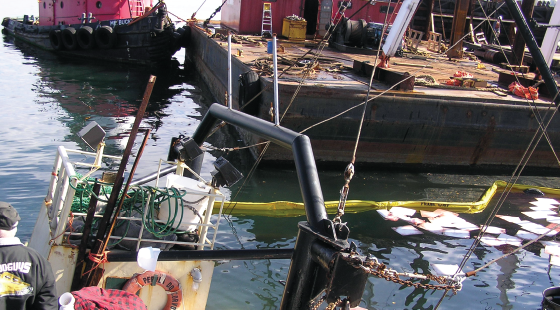
Gasoline is nastier to handle. It has a low flash point and the fumes spread fast. The vapor cloud can travel 50 feet along a dock before it finds a hot engine or a cigarette. Always assume there's a vapor cloud around your fill area when you're pumping gas.
Diesel's less likely to ignite—flash point is around 125°F—but it makes a hell of a mess when spilled. It's oily, it sticks to everything, and it's murder on gelcoat and painted surfaces. The main risk with diesel is environmental contamination and the sheer volume of cleanup required. Diesel spills also create a serious slip hazard on docks.
Ultra-Low Sulfur Diesel (ULSD), which is what you're pumping now, actually has lower electrical conductivity than the old high-sulfur diesel. That means it builds up static more easily. If you're fueling a large diesel tank, grounding is even more critical than it used to be.
What to Do When You Spill
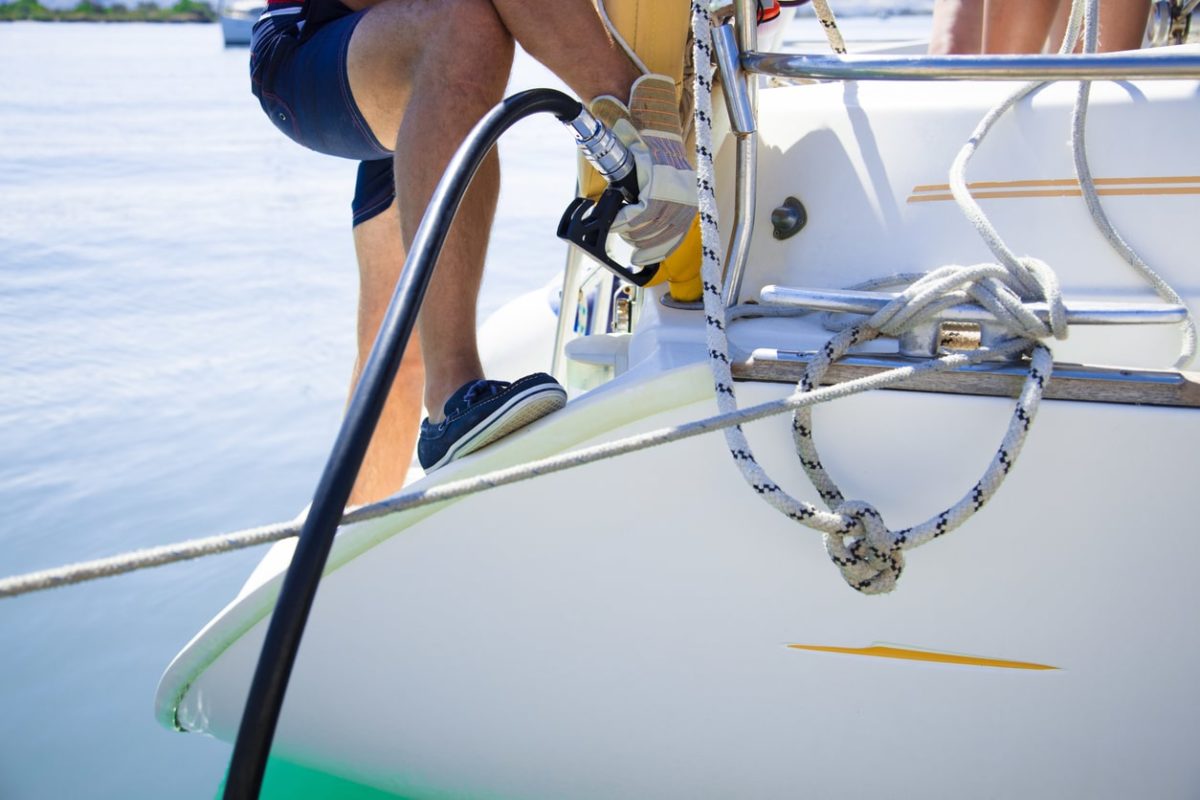
If you spill a significant amount of fuel, your first move is to alert the attendant or dock master. They have spill kits and absorbent materials—usually oil absorbent pads, granular absorbents like Oil-Dri, or containment booms for water spills.
Do not hose it down. Do not try to dilute it with water. You're just spreading it and washing it into storm drains or the water. If the spill is near a storm drain, try to block the drain with absorbent pads or booms if it's safe to do so, but your priority is to get help.
If you get fuel-soaked rags or gloves, don't toss them in the regular trash. Store them in a metal container with a tight-fitting lid—a old paint can works—and keep it outside until you can take it to a hazardous waste disposal site. Gasoline-soaked materials are a fire hazard, especially if they're bunched up where heat can build.
For small drips and splashes on your boat, keep a pack of bilge absorbent pads in your dock box. Toss a couple around the fill neck before you start pumping to catch any blowback when you pull the nozzle out. On boats, we also use absorbent collars that fit around the nozzle—they're cheap and they work.
Fuel Spills and the Law

Environmental Protection Agency and Coast Guard regulations are no joke. If you spill enough fuel to create a sheen on the water (and "enough" can be as little as a quart), you're legally required to report it. The fines start at over a thousand dollars for the first offense and go up fast for repeat violations or larger spills.
Some states, like Colorado, incentivize gas stations to upgrade their underground tanks and leak detection systems by offering reimbursements up to $30,000 per tank. They've achieved 93% compliance with EPA leak-prevention rules—second-highest in the country—by reducing cleanup reimbursements for non-compliant stations. That's kept the average tank age down to 25 years and cut the number of contamination sites.
You don't get those incentives as a boat owner, but the principle is the same: prevent the spill in the first place, because the cleanup is expensive and the liability is serious. For more tips on boat maintenance and parts to keep your fuel system in top shape, explore our full range at JLM Marine.
New Tools That Actually Help
Static grounding technology has improved. Some newer fuel docks use grounding clips that attach to your boat's fill neck and run a wire to a grounded post, ensuring continuous discharge. We've also seen absorbent fuel neck collars that magnetically attach around the fill opening—they catch drips and blowback automatically.
Portable fuel containers now come with better flame arrestors and self-closing spouts. The old yellow vents that you had to open manually are being phased out in favor of automatic pressure-relief designs. If you're still using a 10-year-old gas can with a separate vent cap, replace it. The new designs are worth the money.
For commercial operators and anyone fueling regularly, mobile fueling services have proven safer than traditional pump stations. A Columbia University study of 30 mobile fueling events by a company called Booster showed zero ground spills, compared to the 16.6% spill rate at gas stations. They use absorbent pads under every nozzle and trained professionals who do nothing but fuel vehicles all day. If you're managing a fleet, it's worth looking into.
Your Daily Habit
After every time you fuel your boat, take 30 seconds to check the fuel line connections at the engine and the fuel/water separator. Look for seeps, discoloration, or the smell of gas where there shouldn't be any. Most fuel system problems start as a small weep that turns into a spray once the engine vibrates under load. Catching it early saves you from a fire or a failed fuel pump in the middle of the bay. To find quality replacement parts for your fuel systems, refer to our Fuel & Induction parts collection.
Keep a basic spill kit in your dock box: a dozen absorbent pads, a pair of nitrile gloves, and a small oil containment boom if you're on the water. You'll use it.
For ongoing marine engine care and maintenance, be sure to explore additional tips and replacement parts featured in our Boat Accessories collection.
For your convenience and safety, explore JLM Marine's homepage to find all essential parts and resources designed to keep your boat running smoothly and safely.
Hi—I’m Jim Walker
I grew up in a Florida boatyard, earning pocket money (and a few scars) by rebuilding outboard carbs before I could drive. That hands-on habit carried me through a Ph.D. in mechanical engineering, where I studied how salt water quietly murders metal.
I spent ten years designing cooling systems for high-horsepower outboards, then joined JLM Marine as CTO. We bench-test every new part in the lab, but I still bolt early prototypes onto my own 23-foot skiff for a weekend shake-down— nothing beats real wake and spray for finding weak spots.
Here on the blog I share the fixes and shortcuts I’ve learned so your engine—and your day on the water—run smooth.

For Outboard Owners:
To assist you in maintaining and repairing your marine engines, we hope the following resources may be of use:
-
Fuel Pumps from JLM Marine
-
Fuel Pump Kits from JLM Marine
About JLM Marine
Founded in 2002, JLM Marine has established itself as a dedicated manufacturer of high-quality marine parts, based in China. Our commitment to excellence in manufacturing has earned us the trust of top marine brands globally.
As a direct supplier, we bypass intermediaries, which allows us to offer competitive prices without compromising on quality. This approach not only supports cost-efficiency but also ensures that our customers receive the best value directly from the source.
We are excited to expand our reach through retail channels, bringing our expertise and commitment to quality directly to boat owners and enthusiasts worldwide.
Fuel Pump on Sale
- $73.50
$88.00- $73.50
- Unit price
- per
- $16.00
- $16.00
- Unit price
- per
- $17.99
$21.00- $17.99
- Unit price
- per

- $18.99
- $18.99
- Unit price
- per

- $21.99
- $21.99
- Unit price
- per

- $45.99
$55.00- $45.99
- Unit price
- per

- $23.59
$28.00- $23.59
- Unit price
- per

- $28.99
$34.00- $28.99
- Unit price
- per

- $21.99
- $21.99
- Unit price
- per
- $46.50
$60.00- $46.50
- Unit price
- per
- $26.80
- $26.80
- Unit price
- per
- $24.80
- $24.80
- Unit price
- per
- $28.90
- $28.90
- Unit price
- per

- $27.77
- $27.77
- Unit price
- per

- $56.99
- $56.99
- Unit price
- per

- $129.95
$155.00- $129.95
- Unit price
- per

- $31.20
$37.00- $31.20
- Unit price
- per

- $129.95
$155.00- $129.95
- Unit price
- per
- $138.00
- $138.00
- Unit price
- per
- $24.80
$45.00- $24.80
- Unit price
- per