


VHF Calls and Engine Failure: How to Signal for Help
- VHF Marine Radio: Your Primary Lifeline
- Mayday vs. Pan-Pan: When to Use Each
- How to Make a Mayday Call on VHF Radio
- Visual Distress Signals: When Radio Fails or You Need to Be Seen
- EPIRB and PLB: Satellite Backup for Total Failures
- Backup Communication: Cell Phones and Satellite Messengers
- Practice and Maintenance: The Difference Between Prepared and Panicked
- How Recreational vs. Commercial Rules Differ
- Real-World Example: When Mayday Saves Lives
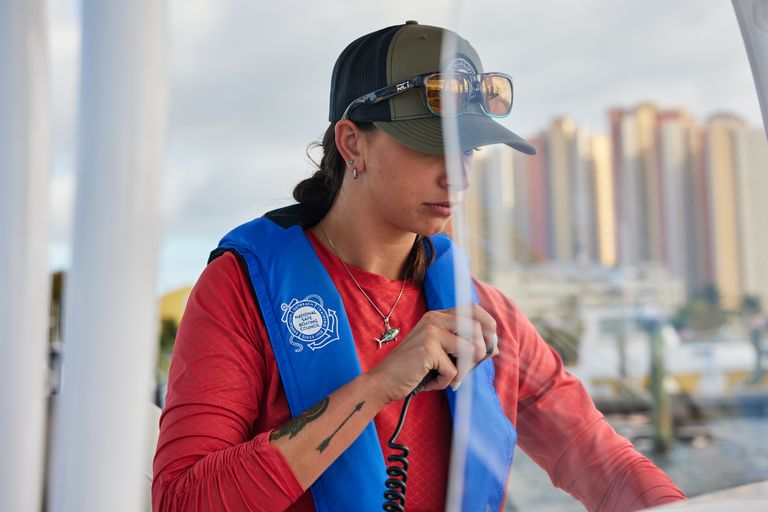
If your engine quits offshore, your VHF radio is your lifeline. I've worked on outboards for twenty years, and I've seen too many boats towed in because the crew didn't know how to call for help properly. This isn't about theory—it's about the exact steps you take when the motor dies and you're drifting.
VHF Marine Radio: Your Primary Lifeline
Your VHF operates in the 156-174 MHz range with a typical range of 20-30 miles from shore or other vessels. Cell phones drop signal fast once you're offshore—VHF doesn't. The U.S. Coast Guard monitors Channel 16 continuously, 24/7. That's your distress, safety, and calling channel.
Before you leave the dock, check three things on your radio: confirm it's set to high power (not low), verify the squelch knob is adjusted so you can hear faint transmissions without static blasting through, and make sure the channel selector lands cleanly on 16. A loose channel knob can drift off-frequency when you need it most.
Range comparison: Cell towers on land can reach 20+ miles, but over water, cell signal degrades to roughly 5-10 miles depending on tower height and your antenna. VHF is line-of-sight, so a 25-foot antenna height gives you about 6 nautical miles to another vessel at sea level, but 20-30 miles to a Coast Guard tower or tall ship antenna. That's why VHF wins offshore.
Digital Selective Calling (DSC): The Red Button
Modern VHF radios have a red DSC distress button under a spring-loaded cover. Hold it for 5 seconds. This sends a digital alert with your position (if you have GPS connected) to the Coast Guard and nearby DSC-equipped vessels on Channel 70.
Critical: DSC only works if you've programmed your MMSI number (Maritime Mobile Service Identity) into the radio. Without an MMSI, the red button transmits a distress signal, but rescue coordinators won't know who you are or where you are unless you have GPS linked to the radio. Register your MMSI free at the FCC if you're a U.S. recreational boater, or through BoatUS if you don't have a station license.
After you hit the DSC button, always follow up with a voice Mayday call on Channel 16. The Coast Guard states: "Once the distress alert is transmitted, contact the Coast Guard on VHF channel 16 and communicate your distress information. The Coast Guard will digitally acknowledge your distress alert if you are in VHF range."
Troubleshooting: Is Your Radio Actually Transmitting?
If you press the transmit button and get no response, check:
- TX indicator light: Most radios show a red or orange "TX" light when transmitting. No light means the mic cord is bad or the radio isn't keying up.
- Amp draw: If you have a voltmeter on the dash, watch it. VHF radios pull 5-6 amps on high power when transmitting. No voltage drop means the radio isn't transmitting.
- Antenna connection: A loose PL-259 connector at the radio or antenna base kills transmission. Hand-tighten it before leaving the dock.
If the radio still won't transmit, switch to visual signals and any backup communication you have.
Mayday vs. Pan-Pan: When to Use Each
Mayday is for grave and imminent danger to life. Total engine failure offshore, sinking, fire, or serious injury. The Coast Guard is clear: Channel 16 is for distress, safety, and calling—not radio checks or casual traffic.
Pan-Pan is for urgent situations that aren't immediately life-threatening. Engine overheating that you might fix, a fuel leak you've contained, or a medical issue that's serious but stable. Pan-Pan gets you priority assistance without triggering a full SAR (search and rescue) launch.
Example of the difference: If your Yamaha 150 throws a rod and you're taking on water through the transom, that's a Mayday. If the same motor overheats and shuts down but you're stable, drifting, and want a tow, that's Pan-Pan.
The Coast Guard warns that false or non-essential distress calls "can hinder genuine distress calls, waste valuable resources, and put responding personnel in danger." Don't cry wolf.
Legal Consequences of Misuse
Hoax Mayday calls violate FCC regulations and can result in fines up to $10,000 and criminal penalties. The Coast Guard will investigate. If you transmit Mayday accidentally (kids playing with the radio, bumped the DSC button), immediately call back on Channel 16 and say: "All stations, all stations, this is [your boat name], cancel my distress alert, cancel my distress alert. Accidental transmission. Out."
How to Make a Mayday Call on VHF Radio
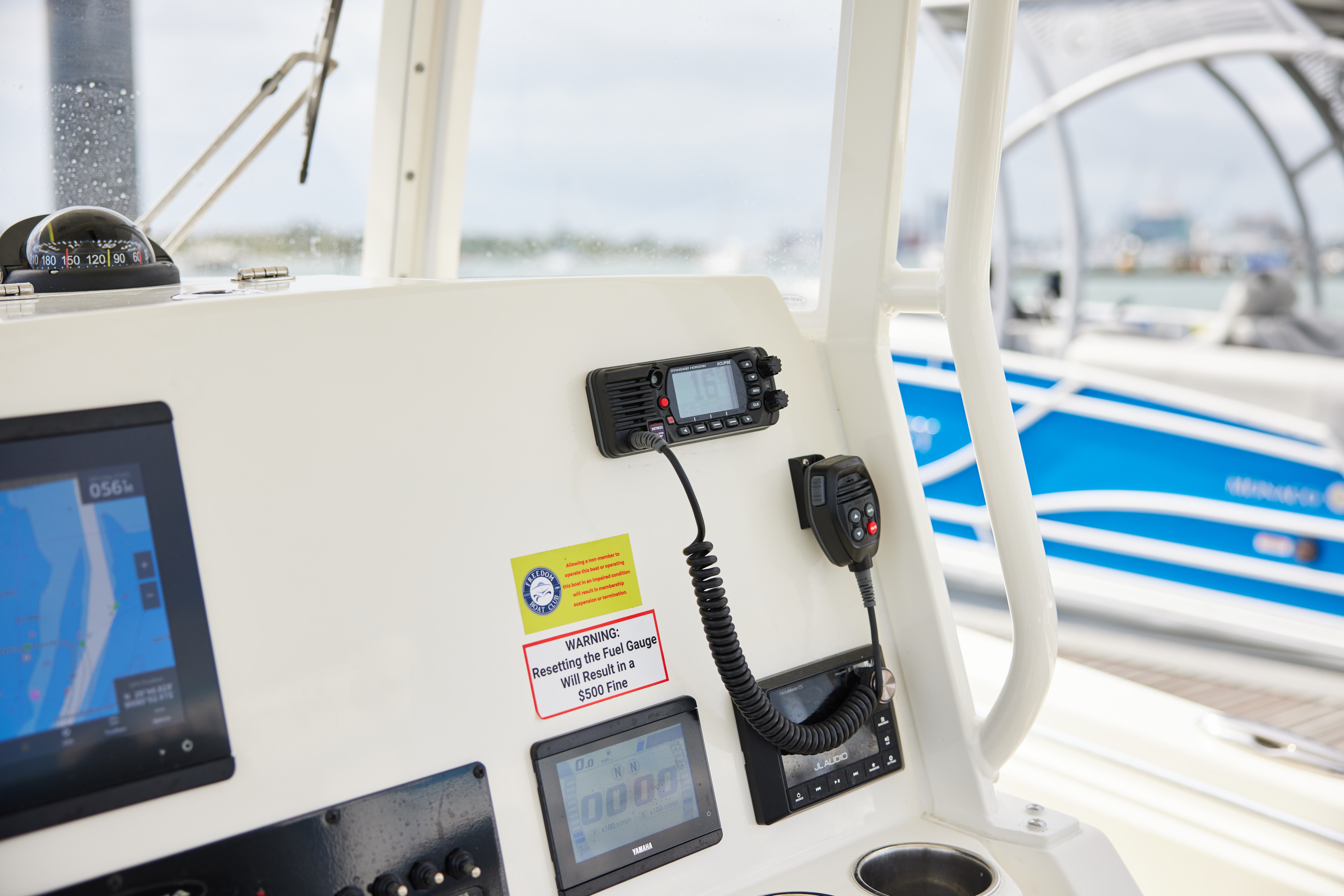
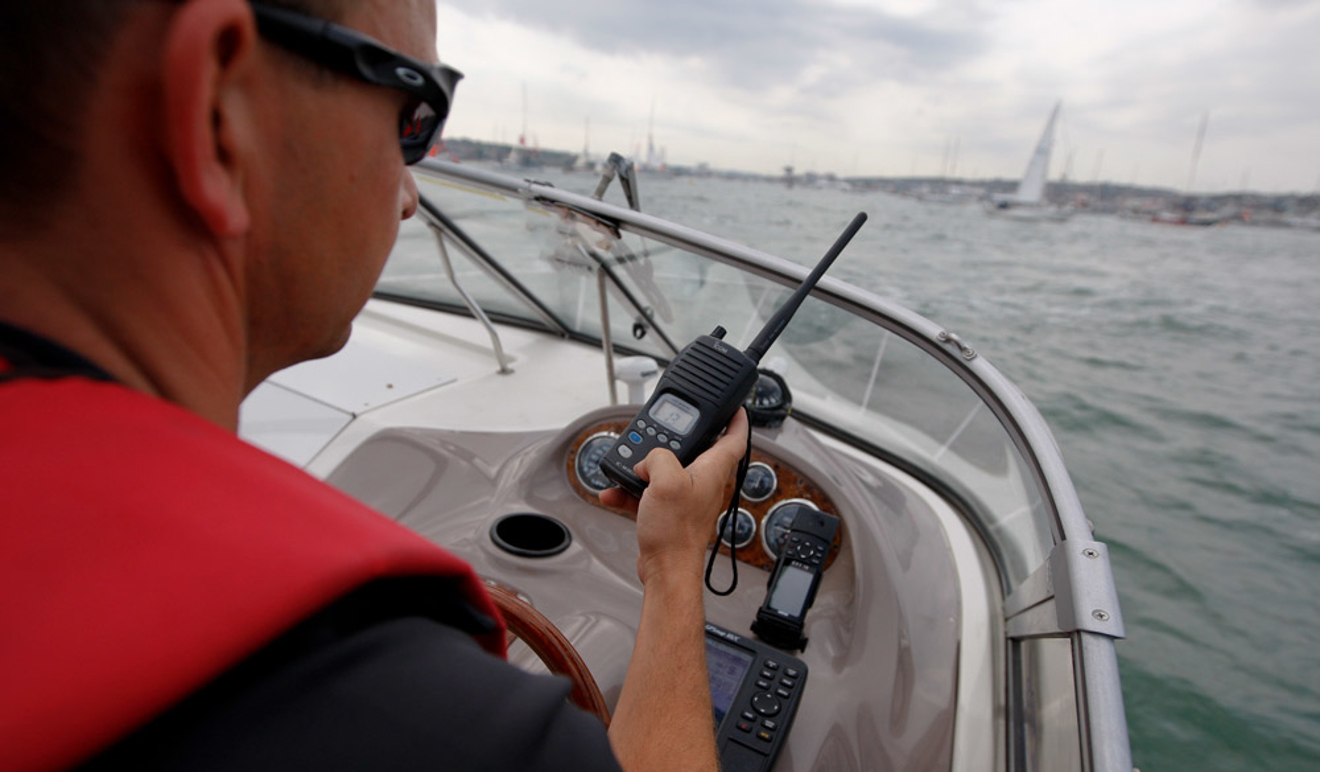
The Coast Guard says you may only have seconds to send a distress call. Use the MIPDANIO format—it's the checklist that ensures you don't forget critical information under pressure.
MIPDANIO Format
- Mayday: The distress word (say three times)
- Identity: Your boat's name and call sign
- Position: Latitude/longitude or bearing/distance from a landmark
- Distress type: Engine failure, sinking, fire, medical, etc.
- Assistance: What help you need (tow, pump, medical evacuation)
- Number: Souls on board
- Injuries: Yes/no, describe if yes
- Other information: Boat description, color, length, any hazards
Example Mayday Script
"Mayday, Mayday, Mayday."
"This is fishing vessel Sea Spray, Sea Spray, Sea Spray. White 28-foot center console, blue Bimini top."
"My position is 3 miles east of Barnegat Inlet, bearing 090 degrees true from Barnegat Light."
"My distress is total engine failure. I am dead in the water and drifting toward the jetty."
"I require immediate tow assistance."
"Four persons on board, all wearing life jackets."
"No injuries."
"Wind is 15 knots southeast, seas 3-4 feet. Visibility good. Over."
BoatUS Foundation advises: "Try to speak slowly and clearly, and repeat this information three times. The essential information is Mayday, your position, and your emergency."
Keep a laminated card with this script taped next to your VHF. When your heart's pounding and the boat's rolling, reading is easier than remembering.
What to Do If You Get No Response
If you transmit on Channel 16 and hear nothing:
- Wait 30 seconds, then repeat the call. The Coast Guard or another vessel may be responding to a different emergency.
- Switch to Channel 22A (157.1 MHz), the Coast Guard's primary working channel in most areas. Try your Mayday there.
- Activate your DSC distress button if you haven't already. The digital signal has a better chance of being received than voice in poor conditions.
- Try other channels monitored by commercial traffic: Channel 13 (bridge-to-bridge, monitored by large vessels), or Channel 9 (recreational calling in some regions, though less common now).
If you're truly out of VHF range, your next step is an EPIRB or PLB.
Communication Etiquette After Contact
Once the Coast Guard or another vessel responds to your Mayday, they'll direct you to switch to a working channel—usually Channel 22A—to clear Channel 16 for other distress calls. Follow their instructions immediately. Staying on 16 after contact clogs the emergency channel.
If you hear another vessel declare Mayday and the Coast Guard responds with "Seelonce Mayday" (silence Mayday), stop transmitting on Channel 16 immediately unless you also have an emergency. Seelonce Mayday means all stations must maintain radio silence so the distress communication can continue without interference. You can resume using 16 when you hear "Seelonce Feenee" (silence finished).
Visual Distress Signals: When Radio Fails or You Need to Be Seen
VHF gets the message out, but visual signals get you spotted by rescue boats or aircraft. Federal regulations (33 CFR 175.110) require recreational vessels over 16 feet on coastal waters to carry USCG-approved visual distress signals.
Daytime Signals
- Orange distress flag: A 3x3 foot orange flag with a black square and ball. Fly it high where it can be seen. Good for general visibility.
- Orange smoke flare: Handheld or floating. Produces a bright orange smoke plume visible for miles. Effective in daylight, especially for marking your position for aircraft or distant vessels.
Nighttime Signals
- Red handheld flares: Burn for 60 seconds at 500 candlepower. Hold at arm's length, downwind, away from your face and the boat. Point it toward the horizon, not straight up—you want the rescue vessel to see it, not satellites.
- Red aerial flares (meteors): Launched from a handheld pistol or self-contained launcher. Reaches 500+ feet, burns for 6-8 seconds. Visible for 20+ miles in clear conditions. Fire downwind and at a 60-degree angle, not vertical. Vertical shots make the flare hard to spot and waste its visibility time.
- SOS electric distress light: An electric torch that flashes the SOS pattern (three short, three long, three short). Required on some vessels, less common on small recreational boats, but effective and reusable.
SOLAS vs. Standard Flares
If you're running offshore—more than 50 miles from the coast—consider SOLAS-grade flares. SOLAS (Safety of Life at Sea) flares burn longer (40+ seconds for handheld, 30+ seconds for aerial), brighter, and are built to stricter international standards. They cost more, but they work better in rough seas and high winds. For coastal and inland boaters, standard USCG-approved flares meet legal requirements.
Check expiration dates every month. Flares have a service life of 42 months from manufacture. Expired flares may not ignite or burn weakly. I've seen boats towed in with flares from 2015 still in the bracket—totally useless. Replace them before they expire, and carry extras. The legal minimum is three day/night signals, but I carry six.
How Rescue Aircraft Spot You at Night
Beyond flares, rescue helicopters and fixed-wing aircraft use infrared (IR) and radar. If you have a radar reflector (a metal or plastic corner-reflector device), mount it as high as possible on your T-top or antenna mast. This increases your radar signature from a small fiberglass hull (almost invisible) to a strong target.
At night, orient your boat so the bow or stern faces the direction of rescue approach if you hear or see a helicopter. This presents the largest radar cross-section. If you have a strobe or flashlight, point it at the aircraft once it's close—don't shine it continuously, as pilots can mistake it for another vessel.
EPIRB and PLB: Satellite Backup for Total Failures
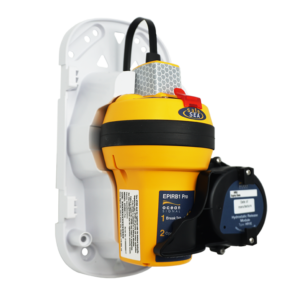
If you're beyond VHF range or your radio is dead, your Emergency Position Indicating Radio Beacon (EPIRB) or Personal Locator Beacon (PLB) is your last-resort lifeline.
EPIRB Overview
An EPIRB transmits on 406 MHz to satellites in the Cospas-Sarsat system, which relay your position to rescue coordination centers (RCC) worldwide. Modern EPIRBs have built-in GPS, so the alert includes your exact coordinates—accurate to within 100 meters.
Float-free vs. manual activation: Most boat-mounted EPIRBs are in a bracket with a hydrostatic release. If the boat sinks and reaches 4-10 feet of depth, the release activates, the EPIRB floats free, and begins transmitting automatically. You can also activate it manually by removing it from the bracket and flipping the switch.
Battery life: EPIRB batteries last 5-10 years depending on model. Once activated, they transmit for 48 hours minimum. Check the expiration date stamped on the unit annually.
PLB Benefits and Use
A PLB (Personal Locator Beacon) is a smaller, portable 406 MHz beacon designed to be carried on your person—clipped to a life jacket or ditch bag. It's manually activated only, with a spring-loaded antenna you pull out. Once on, it transmits your GPS position to the same satellite network as an EPIRB.
PLBs are ideal for:
- Solo kayakers, jet skiers, or paddleboarders who don't have a mounted radio.
- Crew on larger vessels as a backup if separated from the boat (man overboard).
- Small boats under 16 feet where an EPIRB mount isn't practical.
Battery replacement: PLB batteries are typically factory-sealed and must be replaced by the manufacturer or authorized service center every 5-7 years. You can't swap them yourself like AA batteries.
EPIRB vs. PLB for Your Boat
- Recreational vessels 20+ feet, offshore use: Install an EPIRB. It's your boat's emergency beacon, and the float-free capability is critical if you sink fast.
- Small boats, coastal day trips: A PLB is sufficient if you're always within VHF range and not going offshore.
- Serious offshore cruisers: Carry both. EPIRB stays on the boat, PLBs on each crew member's life jacket.
Registration: Non-Negotiable
Register your EPIRB or PLB immediately with NOAA's National Beacon Registration Database. Without registration, the satellite receives your distress signal and position, but the RCC has no idea who you are, what vessel you're on, or who to contact. This delays rescue by hours or days while they try to identify you.
Registration is free, takes 10 minutes, and you update it online whenever you change boats or contact info.
Self-test your beacon every 6 months. Most units have a test button that checks the battery, circuitry, and GPS without transmitting a full distress signal. If the test fails, replace the battery or send the unit in for service. A dead EPIRB is worse than no EPIRB—it gives you false confidence.
Backup Communication: Cell Phones and Satellite Messengers

VHF is primary, but cell phones have a role as supplemental tools.
When Cell Phones Work
If you're within 5-10 miles of shore and have signal, dial 911 or the Coast Guard directly:
- Coast Guard Sector Contact Numbers vary by region. Program your local sector into your phone before you leave. For example, Sector Delaware Bay: (215) 271-4960. Find your sector at uscg.mil.
Cell phones are also useful for:
- Pre-programmed emergency contacts: TowBoatUS, Vessel Assist, or Sea Tow if you need commercial towing (non-emergency).
- GPS position sharing: If your VHF doesn't have GPS, use your phone's GPS to relay coordinates to the Coast Guard.
- Weather updates if your radio dies.
What Cell Phones Don't Do
Cell calls are one-to-one. A VHF Mayday broadcasts to all vessels and Coast Guard stations within range—dozens of potential responders. A cell call to 911 goes to a single dispatcher who then relays it to the Coast Guard. You lose 5-10 minutes in that chain.
Cell phones also die. VHF radios are wired to your boat's battery. A sealed phone in a waterproof case might last a few hours; a VHF lasts as long as your battery does.
Satellite Communicators
Devices like Garmin inReach or SPOT Gen4 use satellite networks (Iridium or Globalstar) to send SOS alerts and GPS coordinates from anywhere on earth. They're popular with offshore sailors and cruisers.
- Pros: Work anywhere, no cell or VHF range limits. Two-way messaging models (inReach) let you communicate with rescue coordinators.
- Cons: Require a subscription ($12-$65/month depending on plan). Not a replacement for VHF or EPIRB—they're an additional layer.
If you're coastal and within VHF range 90% of the time, a satellite communicator is optional. If you're crossing the Gulf Stream or running 100 miles offshore, consider one.
Practice and Maintenance: The Difference Between Prepared and Panicked
Equipment doesn't save you—knowing how to use it does.
Drill Your Crew
Run a distress call drill before every offshore trip. Assign roles:
- Skipper: Makes the VHF call.
- Crew 1: Activates DSC or EPIRB if needed.
- Crew 2: Prepares visual signals (flares, flag) and monitors for rescue vessels.
- Crew 3 (if present): Gets life jackets on everyone and readies the ditch bag.
Practice saying the Mayday script aloud. It sounds silly when the motor's running fine, but muscle memory works. The first time you say "Mayday" shouldn't be in a real emergency.
Many VHF radios have a "training mode" that lets you simulate calls without transmitting. Use it. If your radio doesn't, practice on land with the antenna disconnected.
Monthly Equipment Checks
Flares and smoke signals: Check expiration dates. Replace if they're within 6 months of expiring—don't wait until the day they expire. Store flares in a watertight container, not loose in a ditch bag where they can corrode.
VHF radio: Press the transmit button and watch the TX light. Ask a friend on another boat to confirm they hear you on Channel 16, then immediately switch to 68 or 72 (non-emergency working channels) to finish the test. Never use Channel 16 for radio checks—the Coast Guard explicitly warns against it.
EPIRB/PLB: Run the self-test. If the unit has a GPS test mode, verify it's acquiring satellites. If you get an error, contact the manufacturer.
Batteries: VHF handheld radios use rechargeable lithium-ion or NiMH packs. Charge them after every trip. Fixed-mount VHFs pull power from the boat's electrical system—check your house battery voltage before leaving the dock. A dead battery kills your radio.
Pre-Departure Checklist
Tape this next to your ignition:
- [ ] VHF radio on, set to Channel 16, high power
- [ ] DSC radio programmed with MMSI
- [ ] Flares in date, accessible
- [ ] EPIRB/PLB tested in last 6 months, registered
- [ ] Life jackets on or within arm's reach
- [ ] Ditch bag stocked (handheld VHF, GPS, flares, whistle, water, strobe)
- [ ] Cell phone charged, Coast Guard sector number programmed
How to Cancel a Mayday
If you transmit a Mayday or activate DSC by mistake, or if the situation resolves before rescue arrives (engine restarts, leak stops), you must cancel the call immediately. Leaving an active Mayday wastes SAR resources and puts rescue crews at risk.
Voice cancellation on Channel 16:
"All stations, all stations, all stations, this is [your boat name], [your boat name], [your boat name]. Cancel my Mayday. Cancel my Mayday. Cancel my Mayday. Situation resolved. [Brief explanation, e.g., 'Engine restarted, returning to port under own power.'] Out."
If you used DSC, call the Coast Guard on Channel 16 to confirm cancellation. They may ask for your MMSI or boat registration to verify.
"Seelonce Feenee" is spoken by the Coast Guard or rescue coordinator when a distress situation is resolved and Channel 16 is clear for normal traffic again. You'll hear: "All stations, all stations, Seelonce Feenee." That's your signal that the emergency is over.
How Recreational vs. Commercial Rules Differ

These procedures apply to recreational vessels—boats used for pleasure, not-for-hire. Commercial vessels (charter fishing boats, tugboats, cargo ships) must comply with the Bridge-to-Bridge Radiotelephone Act and maintain a continuous watch on Channel 13 (bridge-to-bridge) in addition to Channel 16. If you're running a six-pack charter (under 6 passengers), you're technically commercial and subject to stricter watch-standing rules. Check FCC Part 80 for details.
Inland vs. coastal waters: Inland boaters (Great Lakes, rivers, lakes) are still required to carry visual distress signals if the vessel is over 16 feet, but the specifics vary slightly by state. Coastal waters (Atlantic, Pacific, Gulf of Mexico) follow strict USCG requirements. Know your zone.
Real-World Example: When Mayday Saves Lives
In 2021, United Airlines Flight 328, a Boeing 777, suffered a catastrophic engine failure shortly after takeoff from Denver. The crew calmly declared "Mayday" to Denver ATC, who immediately cleared airspace and vectored the aircraft back to the airport. All 231 people aboard survived, and the plane landed safely 40 minutes later. The key: precise communication under pressure, using the correct distress terminology, and following ATC instructions exactly.
The same principle applies on the water. A fishing boat 30 miles offshore lost power in 2019 near Cape May, New Jersey. The skipper hit the DSC button, followed with a Mayday call on Channel 16, and gave his GPS position. The Coast Guard diverted a nearby commercial vessel to stand by while a helicopter launched from Air Station Atlantic City. The crew was hoisted off the sinking boat 90 minutes later—because the Mayday gave rescuers exact coordinates and the nature of the distress immediately.
Daily maintenance tip: Before starting your outboard, pull the emergency kill switch lanyard and confirm the engine won't start without it clipped in. A working kill switch can save your life if you're thrown from the helm, and it takes five seconds to test.
For ongoing maintenance and parts to help keep your outboard engine reliable, consider exploring the extensive range of boat accessories and outboard motor parts available direct from factory at JLM Marine. Proper care and using quality components significantly reduce the risk of engine failure offshore.
Also, to understand more about signs of engine trouble that can help you prevent falling victim to sudden motor breakdowns, our guide on signs your outboard impeller needs replacement is a highly recommended resource.
Learning how to replace a Mercury outboard water pump impeller and the importance of water pump maintenance can also make the difference in preventing engine overheating, a common cause of engine failure that leads to distress calls.
Finally, keep in mind the JLM Marine home page as your central hub for all parts, accessories, and expert advice to ensure your boat is always prepared, helping you avoid emergency situations offshore.