
High Altitude Boating: Tuning Your Engine for Thin Air
- How Elevation Kills Power
- Carbureted Engines Need Manual Jetting
- Fuel Injection Handles Altitude Automatically
- Forced Induction: Turbochargers and Superchargers
- Propeller Pitch: The Most Important Adjustment
- Gear Ratio Changes for Sterndrives
- Hull Loading and Weight Distribution
- Cooling System Considerations at Altitude
- Returning to Sea Level: The Forgotten Risk
- Health and UV Exposure at High Elevation
- Tools and Diagnostic Equipment
- When to Call a Dealer
Your boat's struggling to plane at a mountain lake, top speed is down, and the engine can't hit proper RPM. Before you panic about a mechanical failure, understand this: it's the altitude. At 5,000 feet, your engine loses about 15% of its horsepower. At 9,000 feet, that 150 HP outboard is effectively a 110 HP motor.
The problem is oxygen. Thinner air means less oxygen per intake stroke, which means less fuel burns efficiently, which means less power. For naturally aspirated engines, this loss is predictable—roughly 3% per 1,000 feet above sea level, according to Mercury Marine's altitude guidelines.
The fix depends on your fuel system, your propeller, and sometimes your expectations. Modern fuel-injected engines handle most of the work automatically. Carbureted setups require manual tuning. Either way, you'll likely need a different propeller.
How Elevation Kills Power
Air density drops as you climb. At sea level, atmospheric pressure packs oxygen molecules tight. At 8,000 feet, there's 24% less air density. Your engine's cylinders fill with the same volume of air, but that air contains significantly fewer oxygen molecules.
Combustion requires oxygen. Less oxygen means incomplete fuel burn, which shows up as sluggish acceleration, lower top speed, and an engine that won't reach its rated RPM range. A typical outboard should hit 5,000-6,000 RPM at wide-open throttle. At altitude, it might struggle to break 4,500 RPM with the same propeller you run at sea level.
Density altitude matters more than your GPS elevation. Density altitude accounts for temperature and barometric pressure, giving you the effective altitude your engine experiences. A hot day at 6,000 feet might create density altitude of 8,000 feet. Cold mornings can work in your favor. Smartphone apps and handheld weather stations calculate this. Use them before you tune anything.
Barometric pressure tells you what your engine's intake manifold is working against. At sea level, standard pressure is 29.92 inches of mercury. At 5,000 feet, it's closer to 24.9. That's a measurable reduction in the air your engine can pull in, and your fuel system needs to match it.
Carbureted Engines Need Manual Jetting
Carburetors meter fuel mechanically. They're calibrated for a specific air density. Move to higher elevation without changes, and the mixture goes rich—too much fuel for the available oxygen. You'll see black smoke, smell raw gas in the exhaust, possibly foul plugs, and lose even more power than altitude alone would cost you.
The fix is smaller main jets. For every 2,500 feet of elevation gain, drop one or two jet sizes. On a Holley marine carburetor, this usually means going from a #68 main jet at sea level down to a #65 or #64 at 5,000 feet. The exact number depends on your engine's displacement and the carburetor model. Start conservative—one size down—then test. If the engine still bogs or smokes, go smaller. If it pings or hesitates on acceleration, you've gone too lean.
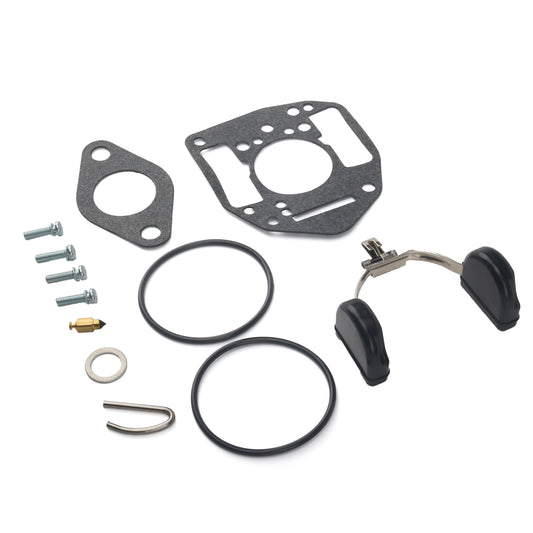
Power valves and metering rods also need attention. The power valve opens under load to add fuel. At altitude, that enrichment happens at lower manifold vacuum due to reduced atmospheric pressure, so you might need a power valve with a lower opening point (e.g., switching from 6.5" to 4.5"). Metering rods control mid-range fuel delivery; if your engine runs rich off idle, consider a leaner metering rod profile. This is tedious work. Carry a jet kit, a vacuum gauge, and a screwdriver set if you're tuning on-site. For more guidance, you can check available carburetor repair kits that help with jetting adjustments.
Flame arrestors on marine carburetors can become a restriction at altitude. These are required by Coast Guard regulations to prevent backfire ignition of fuel vapors, but a clogged arrestor chokes airflow further. Pull it, inspect it, clean it with carburetor cleaner and compressed air. If it's corroded or the mesh is collapsed, replace it. Don't run without one—it's a safety and legal issue—but don't ignore it as a tuning variable.
Fuel Injection Handles Altitude Automatically
EFI systems are the reason most modern boaters don't think about altitude. The ECU reads a manifold absolute pressure (MAP) sensor or a dedicated barometric pressure sensor, measures incoming air temperature and mass airflow, then adjusts injector pulse width in real time. When the MAP sensor reports lower pressure, the ECU cuts fuel delivery proportionally. The result is a consistent air-fuel ratio regardless of elevation.
This doesn't mean you get full power back. The ECU maintains proper combustion, but it can't create oxygen that isn't there. You still lose the 15-24% horsepower that comes from reduced air density. What you gain is reliability—no fouled plugs, no rich-running damage, no need to re-jet every time you trailer to a different lake.
Stock ECU maps have limits. Manufacturers tune for a wide range, but if you're regularly boating above 8,000 feet, the ECU might hit the edge of its compensation table. Symptoms include sluggish throttle response, inability to hit target RPM, or a check-engine light. Aftermarket tuning—reprogramming the ECU or adding a piggyback module—can extend the map's range. This is specialized work. We've seen guys with modified performance engines at Lake Tahoe (6,200 feet) gain back noticeable throttle response with a custom ECU tune that recalibrates fuel and ignition timing for sustained high-altitude operation.
Octane requirements drop at altitude. This surprises people. Detonation risk decreases because cylinder pressure is lower with less dense air. An engine that needs 91 octane at sea level might run fine on 87 at 7,000 feet. This won't give you power back, but it'll save money and prevent carbon buildup from running higher octane than necessary. Monitor for knock or ping; if you hear it, go back up in octane. For detailed information, you might want to review fuel quality and octane choices.
Forced Induction: Turbochargers and Superchargers
Turbochargers compress intake air, forcing more oxygen into the cylinders than atmospheric pressure would naturally provide. At altitude, a turbo can spin faster to compress the thinner air back up to near sea-level density. This is why turbocharged engines lose less power at elevation than naturally aspirated ones.
The turbocharger's wastegate controls boost pressure. At sea level, the wastegate might limit boost to 8 psi. At 8,000 feet, the ECU can command the wastegate to stay closed longer, allowing boost to climb to 10 or 12 psi, effectively compensating for the reduced atmospheric pressure. The engine sees similar intake manifold pressure as it would at sea level, so power loss is minimized.
Tuning turbocharged engines for altitude involves recalibrating boost targets in the ECU. You'll need a boost gauge (mandatory), a wideband oxygen sensor for real-time air-fuel ratio monitoring, and tuning software compatible with your ECU. Increase boost gradually—1-2 psi at a time—and monitor exhaust gas temperature (EGT). If EGT climbs above 1,600°F sustained, you're pushing too hard and risking engine damage. High-altitude turbo tuning is aggressive. We've seen race boats at mountain lakes running 15+ psi of boost to maintain performance, but that requires forged internals and careful fuel mapping.
Superchargers are belt-driven, so they don't respond to exhaust flow like turbos. At altitude, the supercharger still spins at the same speed relative to engine RPM, but it's compressing thinner air. To compensate, increase the blower overdrive ratio—run the supercharger faster by changing pulley sizes. A smaller pulley on the blower or a larger one on the crank increases the speed differential, giving you more boost. This is a mechanical change, not something you tune electronically. Expect to need a new belt and possibly upgraded bearings. The power demand on the supercharger also increases, so watch for belt slip or overheating.
Propeller Pitch: The Most Important Adjustment
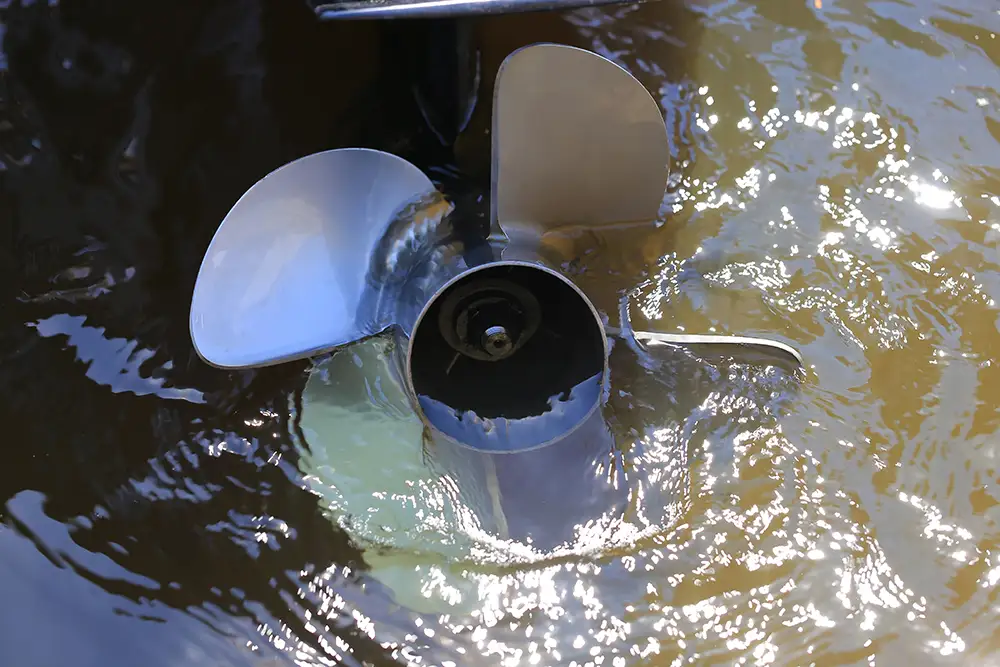
Forget everything else if your propeller pitch is wrong. Propeller pitch is the theoretical distance the prop would move forward in one revolution. A 19-inch pitch prop should move the boat 19 inches per revolution if there were no slip. Lower pitch means the prop takes smaller "bites" of water, making it easier for the engine to spin. Higher pitch means bigger bites, higher load, harder for the engine to turn.
At altitude, your engine makes less power. If you run the same prop you use at sea level, the engine can't overcome the load. It bogs down, won't reach target RPM, and you lose both acceleration and top speed. The solution is a lower-pitch propeller. Drop 2 to 4 inches of pitch for every 3,000-5,000 feet of elevation gain. A boat running a 21-inch prop at sea level might need a 17 or 19 at 7,000 feet.
The trade-off is top speed. Lower pitch increases RPM, which improves hole shot and mid-range acceleration, but you'll hit your engine's RPM limiter sooner. You might lose 5-10 MPH off your top end. For most recreational boaters, that's acceptable. You want to get on plane quickly and maintain cruising speed, not chase maximum velocity. As Mercury Pro Team member Jarrett Edwards puts it: "When you're fishing at high altitude the first rule is to have the correct prop pitch."
Three-blade vs. four-blade props: At altitude, a four-blade prop often works better. Four blades provide more total blade surface area, which improves grip in the water and helps the boat plane faster with reduced power. The downside is slightly lower top speed compared to a three-blade. For high-altitude lakes where you're already power-limited, the four-blade's better hole shot usually wins. We've seen bass boats at Colorado reservoirs switch to four-blades and cut their time to plane by several seconds, which matters when you're fighting a 20% power deficit.
Carry two props. Serious boaters who travel from sea level to mountain lakes keep a low-altitude prop and a high-altitude prop. Swapping a prop takes 20 minutes with a socket set and a prop wrench. It's cheaper than re-gearing a lower unit and far simpler than re-tuning a carburetor every trip. Mark each prop with tape indicating its intended elevation range. To find the right propellers, browse our selection of boat accessories including propellers.
Measure your RPM at wide-open throttle after any prop change. Outboards typically want 5,000-6,000 RPM. Sterndrives vary by engine, but most gas inboards target 4,400-5,200 RPM. If you're below range, drop another inch or two of pitch. If you're above range, you're over-propped and risking engine damage from sustained high RPM.
Gear Ratio Changes for Sterndrives
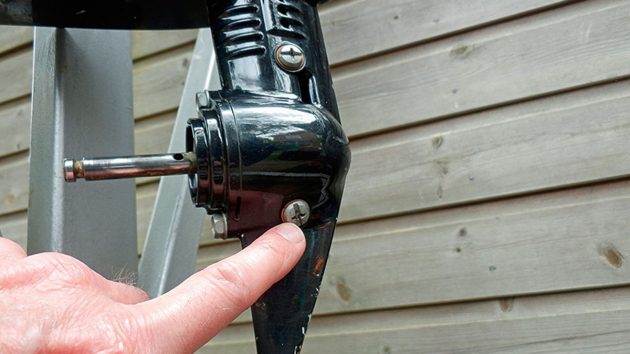
Sterndrive and inboard lower units have a gear ratio that determines how fast the propeller spins relative to engine RPM. A 1.50:1 ratio means the prop turns 1.5 times for every engine revolution. Changing this ratio is a bigger job than swapping a prop, but it's sometimes necessary for high-altitude performance.
A lower numerical gear ratio (e.g., changing from 1.50:1 to 1.75:1 or 2.00:1) allows the propeller to spin faster at a given engine RPM. This is similar to shifting into a lower gear in a car—it reduces the load on the engine, making it easier to reach target RPM. The downside is reduced mechanical advantage, so top-end speed drops.
This is not a field adjustment. It requires pulling the lower unit, disassembling the gearcase, and physically replacing the ring and pinion gears. Most manufacturers offer optional gear sets. Island Lake Marine in Colorado, a dealer at 5,000 feet, keeps multiple gear ratios in stock specifically for altitude customers. Shop owner Scott Jensen explains: "So, even though an engine is fuel injected, it still loses horsepower as you increase in elevation, so we have to address prop pitch and gear ratio."
Gear ratio changes are worth considering if you've already maxed out propeller adjustments and still can't hit target RPM, or if you're running a heavy boat (like a wakeboard boat or large cruiser) where propeller selection alone isn't enough. For most recreational outboard applications, propeller changes handle the problem.
Hull Loading and Weight Distribution
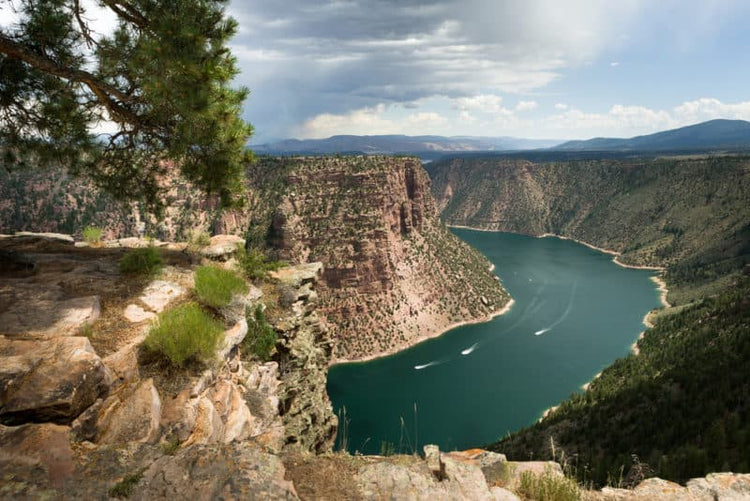
Power loss at altitude makes your boat effectively heavier. Every passenger, every cooler, every full fuel tank matters more when you've lost 20% of your horsepower. Reduce weight anywhere you can. Run with half-full fuel tanks on short trips. Leave unnecessary gear at the dock. This isn't about being cheap; it's about physics.
Weight distribution affects planing. Shift weight forward to get the bow down. A bow-heavy boat planes more easily because the hull's planing surfaces engage sooner. At altitude, where you're already struggling for power, moving passengers or gear toward the bow can cut several seconds off your time to plane. Once you're on plane, you can shift weight back if needed for handling. Trim tabs help here—bow down on the hole shot, then adjust trim as you accelerate. For more about balancing your boat, see our blog on weight distribution for speed and balancing your boat.
Lighter hull designs plane more easily. If you're shopping for a boat specifically for high-altitude use, aluminum hulls beat fiberglass for weight. Deep-V hulls designed for rough water create more drag than modified-V or flat-bottom designs, which matters when power is limited. A bass boat will outperform a deep-V walleye boat at altitude, all else equal.
Cooling System Considerations at Altitude

Water boils at lower temperatures as elevation increases. At sea level, water boils at 212°F. At 5,000 feet, it boils at 203°F. At 10,000 feet, it's 194°F. Your engine's cooling system operates closer to its boiling point, which reduces the margin for error.
Most marine engines run 140-160°F under normal operation, well below boiling even at altitude. But if your cooling system is marginal—partially clogged heat exchanger, weak water pump, restricted raw water intake—altitude can push it over the edge. We've seen engines that ran fine at sea level overheat at 7,000 feet because the cooling system couldn't reject heat efficiently with lower-temperature coolant boiling points.
Monitor your temperature gauge closely on the first few runs at a new altitude. If the needle creeps higher than normal, shut down and investigate. Check the raw water pickup for weeds or debris. Inspect the impeller for wear—a weak impeller that barely kept up at sea level will fail at altitude. To keep your cooling system in good order, consider our cooling system parts and water pump impellers available online.
If you're running a closed-cooling system (freshwater-cooled with a heat exchanger), check coolant level and verify the heat exchanger isn't clogged.
Consider a lower-temperature thermostat if you're frequently boating above 8,000 feet. Dropping from a 160°F thermostat to a 140°F unit gives you more margin before coolant temperatures approach boiling. This is a minor change—pull the thermostat housing, swap the stat, button it back up with a new gasket. Don't eliminate the thermostat entirely; engines need to reach operating temperature for proper combustion and to prevent condensation in the oil. For detailed instructions, see our guide on how to replace the thermostat on your Yamaha outboard.
Returning to Sea Level: The Forgotten Risk
Most articles stop at tuning for altitude. Here's what they miss: if you tune for high elevation and then return to sea level without reversing your changes, you can destroy your engine.
A carburetor jetted lean for 8,000 feet will run dangerously lean at sea level. Lean combustion increases cylinder temperatures, risking piston seizure, burned valves, or detonation damage. If you swapped to smaller jets for the mountains, swap back to your sea-level jets before you launch at the coast.
A low-pitch propeller optimized for altitude will over-rev your engine at sea level. You'll exceed maximum rated RPM, potentially damaging the crankshaft, rods, or valvetrain. If your engine redlines at 6,000 RPM and your altitude prop spins it to 6,500 RPM at sea level, you're asking for a catastrophic failure. Always re-check your propeller when moving between elevations.
EFI engines handle this automatically, which is one more reason they're worth the investment. The ECU sees the barometric pressure change and adjusts fuel delivery. You still need to check your propeller, but the fuel system takes care of itself.
Health and UV Exposure at High Elevation
Altitude affects you, not just the engine. Altitude sickness hits some people above 8,000 feet, causing headaches, nausea, dizziness, and fatigue. It's caused by lower oxygen levels and dehydration. Air at altitude is drier, so you lose moisture faster through breathing and skin evaporation.
Drink water constantly, even if you don't feel thirsty. Avoid alcohol for the first 24 hours at elevation—it worsens dehydration and amplifies altitude sickness symptoms. If someone in your group shows signs of altitude sickness, get them off the water, rest, and descend if symptoms worsen.
UV exposure increases roughly 10% per 1,000 feet of elevation. At 8,000 feet, UV intensity is about 80% higher than at sea level. You'll sunburn faster, even on overcast days. On a boat, you're getting additional UV reflection off the water. Wear long sleeves, a wide-brim hat, and apply sunscreen every two hours. Polarized sunglasses aren't optional—they're necessary to prevent eye damage from reflected glare.
Mountain weather changes fast. A clear morning can turn into afternoon thunderstorms with little warning. Lightning is a serious risk on open water. Check the forecast before you launch, monitor weather radar on your phone, and get off the water if you see storms building. At altitude, temperature swings are extreme—70°F at noon can drop to 40°F by evening. Bring layers.
Tools and Diagnostic Equipment
If you're serious about high-altitude tuning, carry these tools:
- Tachometer or RPM gauge: Non-negotiable. You can't tune a propeller without knowing your actual RPM at WOT.
- Infrared thermometer: Point it at cylinder heads or exhaust manifolds to check for hot spots indicating lean conditions or cooling problems.
- Vacuum gauge: For carburetor tuning, manifold vacuum tells you if your mixture is rich, lean, or correct. Hook it to a manifold port and watch for steady readings at idle.
- Spark plug wrench and spare plugs: Pull a plug after a WOT run and read it. Tan or light gray is good. Black and sooty means rich. White or blistered means lean and dangerous.
- Jet kit for your carburetor: Assortment of main jets, pilot jets, and needles. Holley, Edelbrock, and Mikuni all sell altitude-specific jet kits.
- Propeller wrench and spare prop: Swapping props is the fastest way to test performance changes.
Smartphone apps for density altitude calculation are free and accurate. Use them. Knowing your density altitude before you start tuning saves hours of trial and error.
When to Call a Dealer
Some jobs are DIY-friendly. Swapping a propeller, cleaning a flame arrestor, or adjusting a carburetor's mixture screw—you can handle those with basic tools and common sense. Other jobs require specialized equipment or expertise.
If your EFI system is throwing codes or the engine's going into limp mode at altitude, you need a dealer with the manufacturer's diagnostic software. They can read ECU fault logs, check sensor calibration, and update firmware if needed. If you're modifying a turbocharged engine for sustained high-altitude use, professional dyno tuning is worth the cost. A bad boost map or lean condition under load will detonate the engine, and that's a multi-thousand-dollar mistake.
Gear ratio changes require pulling the lower unit, which means you need a clean workspace, a service manual, and ideally a lift. Most backyard mechanics skip this one and let the dealer handle it. It's not that it's difficult; it's that a mistake (mismatched shims, incorrect backlash, wrong gear oil) leads to expensive repairs.
Dealers in high-altitude regions—Colorado, Wyoming, Utah, northern New Mexico—see this stuff constantly. They know the common fixes for specific engine models and can often diagnose the issue faster than you can Google it. Island Lake Marine in Fort Collins keeps altitude-specific props and gear sets in stock because they deal with it daily. Use that local knowledge.
Before your next high-altitude trip, pull your spark plugs and inspect them. If they're fouled or carbon-loaded, clean or replace them. A weak spark at altitude, where combustion is already compromised, will cost you more power than a prop change can fix.
For all your marine parts needs to help maintain and tune your engine for high altitudes, trust the quality and reliability of JLM Marine, your source for direct factory boat parts.
- carburetor repair kits: carburetor repair kits
- fuel quality and octane: fuel quality and octane choices
- boat accessories and propellers: boat accessories including propellers
- cooling system and water pump impellers: cooling system parts and water pump impellers
- thermostat replacement guide: how to replace the thermostat on your Yamaha outboard
- weight distribution: weight distribution for speed and balancing your boat
- JLM Marine homepage: JLM Marine