







Portable Fuel Tank vs. Built-in Tank: Pros and Cons

After two decades wrenching on outboards, I can tell you the portable versus built-in fuel tank question comes up constantly. The answer isn't one-size-fits-all. It depends on your boat size, how far you run, and whether you're willing to lug tanks around or pay for a permanent installation.
What You Need to Know About Tank Types
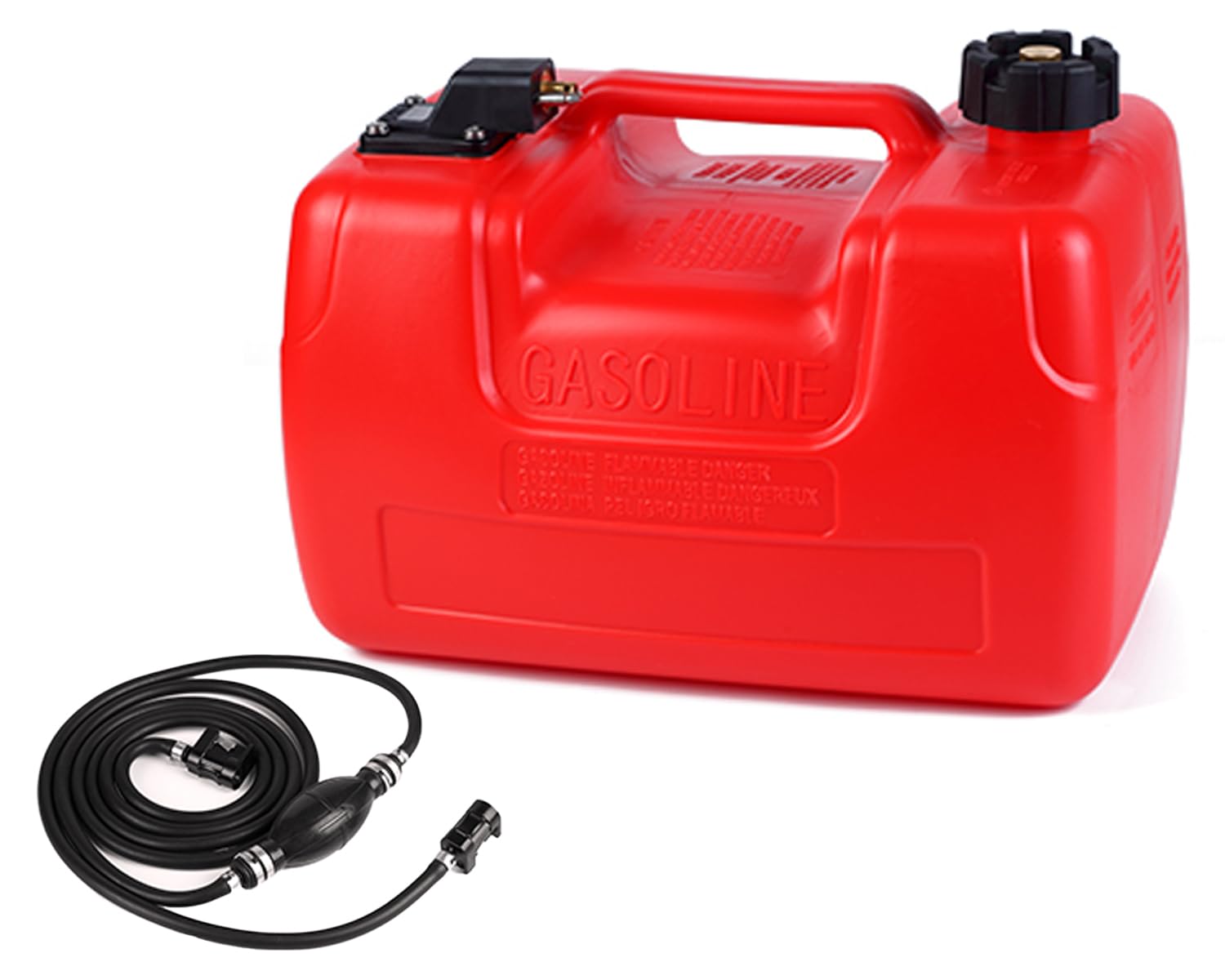
Built-in tanks are bolted or glassed into the hull, plumbed with fixed fill and vent lines, and can't be pulled without cutting fiberglass or removing deck sections. Under 33 CFR 183.501-183.590, any gasoline boat with a permanent tank must meet Coast Guard fire-resistance and construction rules. ABYC H-24 covers the actual plumbing, vent routing, and hose specs for gasoline systems; diesel permanent tanks follow ABYC H-33.
Portable tanks are made to lift out by hand. Most are high-density polyethylene (HDPE) with molded carry handles. They range from the classic 6-gallon red jug up to wheeled 50-gallon carts. Federal fuel-system rules don't apply to outboard boats running only portable tanks, though ABYC H-25 still lays out best practices for portable gasoline setups. For more on marine fuel systems standards and safety, you can also visit our boat accessories collection that includes essential fuel system components.
Why Portable Tanks Work

You Can Move Them
Pull the tank, drive to any gas station, fill it, and drop it back in the boat. No need to maneuver a trailer boat to a fuel dock or pay marina premium prices. On a 4.8-meter Whitley powerboat, one owner ran four 25-liter portable tanks instead of installing an under-deck tank, specifically because he could rotate fuel and shift weight around for trim.
A full 12-gallon portable tank weighs about 90 pounds, so lifting gets hard fast. Larger wheeled units—sometimes up to 106 gallons—come with forklift pockets for marina or worksite handling, but those are overkill for most recreational boats.
Fuel Stays Fresh
Gasoline with 10% ethanol (E10) starts breaking down in 30 to 90 days, depending on storage conditions. Phase separation—where ethanol absorbs water and drops to the tank bottom—clogs carbs and fuel injectors. With portable tanks, you can rotate cans like you rotate spare oil: use the oldest first, top it off, then grab the next one. Leftover fuel goes into the lawn mower or generator, so nothing sits long enough to go stale.
Built-in tanks, especially large ones that rarely get drained, trap old fuel. Pumping out and refilling a 60-gallon aluminum built-in is a job; swapping a 6-gallon portable takes 30 seconds.
Lower Up-Front Cost and Simple Replacement
A decent 12-gallon EPA-compliant portable tank runs $60 to $120. If it cracks, you buy another and toss the old one. Contrast that with a built-in aluminum tank: the tank itself might be $400 to $800, then add fabrication, Coast Guard-compliant hose (Type A1 or B1), fittings, deck fill, vent through-hull, and labor. Replacing a corroded built-in tank often means cutting floors or structures to access it, which can run into thousands of dollars on a mid-sized boat.
Easier Inspection
You can see every square inch of a portable tank. Pull it, flip it over, check for cracks, swelling from sun exposure, or weeping seams. Built-in tanks hide under decks, behind stringers, or in bilges. Corrosion starts where you can't see it—on the back side against a stringer, or at a mounting tab. By the time you smell fuel or see a bilge stain, the damage is done.
Gasoline Vapor Ventilation
Portable gasoline tanks must be stored in well-ventilated spaces because gasoline vapor is heavier than air and will settle in bilges or enclosed lockers. On small boats, portables typically sit on deck or in open cockpits, which naturally vents vapors overboard. This is actually safer than a poorly vented built-in system where a vent line gets blocked or routed wrong and traps fumes.
Modern EPA-compliant portable tanks have integrated "diurnal emission control"—basically a valve or bladder that handles pressure swings from daily heating and cooling. These valves sometimes cause the tank to swell in direct sun, a complaint I hear constantly. It's not a defect; it's how the tank meets EPA evaporative emission limits. Store the tank in shade or cover it, and the swelling goes down.
Downsides of Portable Tanks
Deck Space and Trip Hazards
A 12-gallon tank is roughly 18 inches tall and takes up about one square foot of cockpit real estate. Run three tanks for a longer trip and you've cluttered half your deck. On smaller boats, that's where you stand to fish or move around. Secure them with cam straps or bungees, because a loose tank sliding across the deck in rough water is dangerous. ABYC H-25 recommends restraining portable tanks so they don't become projectiles.
You also can't store gasoline portables in the same locker as batteries or any ignition source. Vapor fire risk is real, so you either dedicate a vented locker or leave them topside.
Limited Capacity and Range
Most outboard portables top out around 12 gallons. Some larger wheeled units go to 25 or 50 gallons, but those are awkward on a boat. If your engine burns 4 gallons per hour at cruise, a single 12-gallon tank gives you three hours. Want a full day offshore? You're hauling four tanks, managing hose swaps, and hoping you don't run one dry mid-run because you forgot to switch.
Trailer-boat owners making short day trips do fine with portables. Offshore guys running 50 or 100 miles quickly hit the point where portable capacity doesn't cut it.
Handling and Spill Risk
Lifting a 90-pound tank over a gunwale or down a dock is where most spills happen. Overfill by half a gallon and it sloshes out the vent when you pick it up. BoatUS spill data shows that most recreational fuel spills occur during transfer—pouring from a jug into a tank, moving containers around, or topping off without a proper funnel. Every transfer is a chance to drip fuel on your deck, into the bilge, or into the water.
Use a no-spill nozzle, a catch pan under the connection, and only refuel on land when possible. Some marinas restrict jerry-can refueling over the water for exactly this reason.
Connector and Hose Compatibility
Portable tanks connect to the engine through quick-disconnect fittings. Yamaha, Mercury, and Suzuki all use slightly different styles. I've seen guys show up with the wrong connector and jury-rig it with hose clamps and a prayer. That's a vacuum leak at best, a fire hazard at worst. Always verify your engine's connector type and match the tank or use the correct adapter. A loose or mismatched fitting can let air into the line, causing fuel starvation and a no-start on the water.
Why Built-in Tanks Work
Range and Capacity
A properly sized built-in tank gives you the range to run offshore, cruise the coast, or fish a full tournament day without swapping tanks. Larger vessels typically install permanent tanks ranging from 30 gallons on a small center console up to several hundred gallons on a sportfish. You check the fuel gauge, not a collection of plastic jugs.
Calculate your engine's burn rate (gallons per hour at cruise) and your typical trip distance. A 90-gallon built-in on a boat burning 6 GPH gives you 15 hours of runtime, enough for a 200-mile round trip offshore with reserve. Try doing that with portable 6-gallon tanks; you'd need fifteen of them.
Clean Deck and Better Weight Distribution
Built-in tanks sit low, often in the bilge or under a console, close to the boat's longitudinal center. This keeps weight where it helps trim and stability. Portable tanks on deck raise the center of gravity and can shift if not properly secured, affecting handling in rough seas. A built-in system also clears your cockpit—no tanks to step over, no hoses snaking across the deck.
Integrated Gauges and Monitoring
Most built-in setups include a fuel sender and dash gauge, so you know exactly how much fuel remains. High-end systems add low-fuel alarms or hour-meter integration. With portables, you're lifting tanks to guess weight or hoping you switched to a full one before the engine dies. Running a tank dry on plane is a quick way to damage a fuel pump or injectors when the engine sucks air.
Compliance and Safety Design
Coast Guard rules 33 CFR 183.501-183.590 mandate that gasoline built-in tanks pass a fire-resistance test (flame for 2.5 minutes without leaking), be properly grounded, use approved fill and vent fittings, and incorporate features that prevent explosive vapor buildup. ABYC H-24 adds detailed rules on hose routing, vent height, and anti-siphon valves.
When you buy a boat with a certified built-in tank, these protections are already in place. The vent terminates above the waterline where it can't back-flood, the fill has a flame arrestor, and the tank is electrically bonded to prevent static sparks. A well-engineered built-in system is safer than a collection of portable tanks if—and only if—it's installed and maintained correctly.
Downsides of Built-in Tanks

Installation Cost and Complexity
Installing a permanent gasoline tank means meeting all the federal and ABYC rules. Marine safety engineers strongly discourage DIY tank fabrication: "I strongly recommend that anyone building boats with permanently installed gasoline tanks not build their own tanks. The reason is simple. You have to certify that whatever you put in this boat meets Federal Regulations."
You'll need Coast Guard Type A1 or B1 fuel hose (which resists permeation and fire), a proper deck fill with a flame arrestor, a vent line that terminates outside the hull at least 12 inches from any opening, anti-siphon protection, and secure tank mounting that isolates the tank from hull flexing. Professional installation on a 20- to 25-foot boat can easily run $2,000 to $4,000 when you include the tank, hardware, labor, and testing.
Hidden Corrosion and Contamination
Aluminum tanks corrode, especially in bilges where they sit in stagnant water or against wet stringers. Stainless and composite tanks fare better, but nothing is immune. Corrosion typically starts on the back side against a mounting surface where you can't inspect it. By the time you notice fuel weeping or a bilge full of gasoline, the tank is often beyond repair.
Water and sediment also settle in the lowest point of a built-in tank. On gasoline systems, this accelerates phase separation. On diesel, it grows algae. Draining and cleaning a built-in tank is a pain. Some tanks have no drain plug at all; you're pumping fuel out through the pickup line or cutting a new access to get inside. Polishing the fuel (filtering it through an external pump and returning it) is the workaround, but it's time-consuming.
Difficult Repairs and Replacement
Replacing a failed built-in tank is a major project. You often have to remove the deck, console, or sole to access it. Tanks are typically installed before the deck goes on during the build, meaning there's no easy way to extract one later. Cutting floors or structural members to pull a tank compromises the hull unless you properly re-glass and reinforce afterward.
I've seen boats where the tank replacement cost more than the boat was worth, and the owner ended up converting to a portable system or scrapping the hull.
Regulatory Testing Burden
Builders of boats with built-in gasoline tanks must either meet USCG fuel-system rules and EPA evaporative-emissions limits, or follow accepted ABYC standards like H-24 as an alternative compliance path. This requires testing, documentation, and often a carbon canister or vent valve to capture fuel vapors. For the average boater, this just means the boat costs more upfront. For someone retrofitting a tank, it's a headache you need a surveyor or certified marine tech to help navigate.
Choosing the Right Tank for Your Boat

Small Boats and Trailer Use
If you own a jon boat, skiff, or inflatable under 18 feet that you trailer to different ramps, portable tanks are the obvious choice. You can remove them for safe land refueling, rotate fuel to keep it fresh, and avoid the cost and complexity of a built-in system on a boat that wasn't designed for one. Portable systems are the norm in this size range.
Carry at least two tanks so you have a backup, and secure both with cam straps or a dedicated rack. Use a quality quick-connect that matches your engine, and inspect hoses for cracks every season.
Mid-Sized Boats and Occasional Cruising
On a 20- to 25-foot center console or walk-around, you're at the tipping point. If you run short trips—inside the bay, a few miles offshore for bottom fish—portable tanks can still work if you have the deck space and don't mind handling them. Some owners install a small built-in tank for primary range and keep one or two portables as backup, which is a solid hybrid approach.
If you're running 30 or 40 miles offshore regularly, invest in a properly sized built-in tank. The convenience, range, and safety features outweigh the higher cost. A 60- to 90-gallon built-in on a boat this size is typical.
Larger Boats and Long-Range Cruising
Anything over 25 feet planning extended offshore trips needs a built-in tank system. Portable tanks simply can't provide the capacity or stability for serious cruising. You'll want a tank large enough to carry fuel for your longest anticipated run plus a 30% reserve, integrated gauges, and possibly dual tanks with a selector valve for redundancy.
Professional installation and adherence to ABYC H-24 or H-33 standards is mandatory for safety and resale value.
Ethanol and Phase Separation
E10 gasoline absorbs water. In a portable tank, you can dump the contaminated fuel or run it through a water separator. In a built-in tank, water settles at the pickup. Phase separation is harder to purge from a built-in system because you can't easily tip the tank to drain it. Use fuel stabilizer, run fresh fuel frequently, and if the boat sits for more than a month, top off the tank to minimize the air space where condensation forms.
For built-in tanks, install a good primary fuel-water separator with a drain and check it before every long trip. On portables, you can simply dump suspect fuel into a clear container and look for the telltale layering of ethanol/water at the bottom.
Material Differences and Longevity
HDPE portable tanks are light and corrosion-proof, but they degrade under UV exposure. Stored on deck in direct sun, the plastic can become brittle over 5 to 10 years. Cover them or store in shade when not in use. Check the manufacturing date stamp before buying; old stock sitting in a warehouse for years may already be degraded.
Aluminum built-in tanks are strong and pass Coast Guard fire tests, but aluminum corrodes in salt or acidic bilge water, especially at welds and fittings. Stainless steel and cross-linked polyethylene (roto-molded) built-in tanks are more corrosion-resistant but cost more. Pitting corrosion in aluminum tanks often appears on the back side against a structural member, so regular bilge inspections and keeping the bilge dry are critical.
Diesel Considerations
Diesel fuel is less volatile than gasoline, so portable diesel tanks don't face the same stringent venting and vapor-control rules. However, diesel grows algae when water is present, and long-term storage in portable tanks can lead to sludge buildup. If you're using portable diesel for a generator or auxiliary engine, rotate the fuel regularly and use a biocide additive to prevent microbial growth.
Diesel built-in tanks follow ABYC H-33 and don't require the same fire-resistance testing as gasoline tanks, which simplifies installation slightly. Still, proper venting, secure mounting, and corrosion-resistant materials are essential.
Real-World Hybrid Approach

Many experienced boaters run a mix. Sailboat owners often keep a built-in diesel tank for the inboard and a portable gas tank for the outboard kicker. Center-console owners sometimes install a modest built-in tank for daily use and carry one or two portables for extended trips or as emergency reserve.
This hybrid setup gives you the range and convenience of a built-in, plus the flexibility and backup of portables. Just make sure both systems are properly secured and vented, and that you're not mixing incompatible fuel types.
Safety, Handling, and Maintenance
Regardless of which system you choose, safe fuel handling is non-negotiable. Most recreational fuel spills happen during transfer—overfilling at the pump, sloshing while moving a tank, or a loose connector. Use a proper fuel nozzle with a shut-off, a catch pan under connections, and never top off a tank on the water if you can avoid it.
For portable tanks, inspect the cap, vent, and quick-disconnect regularly for cracks or wear. Replace any component that's stiff, cracked, or leaking. Store gasoline portables in well-ventilated areas away from ignition sources, and never in a sealed locker with batteries or electrical panels.
For built-in tanks, check the bilge for fuel smell or sheen, inspect all hose clamps and connections annually, and test the vent line to ensure it's clear. Replace fuel hoses every 10 years or sooner if they're soft or cracked; Coast Guard Type A1 or B1 hose is required, not automotive fuel line.
Keep a basic spill kit—absorbent pads, a bilge pump, and a container—on board. If you do spill fuel, contain it immediately and report spills over a certain volume to the Coast Guard (exact threshold varies by location, but it's typically "a sheen on the water").
For a wide range of genuine marine parts, including fuel system components and accessories designed for safety and reliability, browse our full parts catalog at JLM Marine.
Making the Call
Portable tanks win on flexibility, cost, and ease of replacement. Built-in tanks win on range, convenience, and cleaner deck layout. For small boats, short trips, and infrequent use, portables make sense. For larger boats, longer runs, and serious offshore work, built-in is the better long-term investment.
Pro tip: After every trip, crack the fuel cap on your portable tank to release pressure from heat expansion, then tighten it again. This simple habit prevents the tank from swelling in the sun and extends the life of the EPA vent valve.
Sources:
- http://fishwrecked.com/forum/portable-fuel-tank-vs-inbuilt
- https://www.uscgboating.org/assets/1/AssetManager/ABYC.1002.01.pdf
- https://abycinc.org/news/h-24standard/
- https://continuouswave.com/ubb/Forum3/HTML/007821.html
- https://newboatbuilders.com/pages/fuel.html
- https://www.practical-sailor.com/systems-propulsion/diesel-engines/diesel-fuel-tank-replacement
- https://forums.sailboatowners.com/threads/fuel-tank-confusion.190469/
- https://clixfueling.com/blogs/news/marine-portable-fuel-tanks
- https://www.ecfr.gov/current/title-33/chapter-I/subchapter-S/part-183/subpart-J
- https://continuouswave.com/ubb/Forum1/HTML/015984.html
- https://www.boatus.org/findings/40
- https://www.sierraparts.com/blogs/insights/how-to-choose-the-right-fuel-tank-for-your-boat
Hi—I’m Jim Walker
I grew up in a Florida boatyard, earning pocket money (and a few scars) by rebuilding outboard carbs before I could drive. That hands-on habit carried me through a Ph.D. in mechanical engineering, where I studied how salt water quietly murders metal.
I spent ten years designing cooling systems for high-horsepower outboards, then joined JLM Marine as CTO. We bench-test every new part in the lab, but I still bolt early prototypes onto my own 23-foot skiff for a weekend shake-down— nothing beats real wake and spray for finding weak spots.
Here on the blog I share the fixes and shortcuts I’ve learned so your engine—and your day on the water—run smooth.

Для владельцев лодок:
Мы надеемся, что следующие ресурсы окажутся полезными для вас в обслуживании и ремонте ваших судовых двигателей:
- Руководство по серийным номерам Mercury
- Руководства пользователя от Mercury
- Официальное руководство по номерам моделей в формате PDF от BRP
- Руководство по серийным номерам Johnson
-
Аксессуары для лодок от JLM Marine
О компании JLM Marine
Основанная в 2002 году, компания JLM Marine зарекомендовала себя как специализированный производитель высококачественных морских деталей, базирующийся в Китае. Наша приверженность совершенству в производстве заслужила нам доверие ведущих мировых морских брендов.
Как прямой поставщик, мы обходим посредников, что позволяет нам предлагать конкурентоспособные цены без ущерба качеству. Такой подход не только поддерживает экономическую эффективность, но и гарантирует, что наши клиенты получают наилучшую ценность напрямую от источника.
Мы рады расширить свое присутствие через розничные каналы, предлагая наш опыт и приверженность качеству непосредственно владельцам и любителям лодок по всему миру.
Распродажа лодочных аксессуаров
- $54.00
- $54.00
- Unit price
- per
- $38.50
- $38.50
- Unit price
- per
- From $39.13
$45.50- From $39.13
- Unit price
- per


- $53.50
- $53.50
- Unit price
- per
- From $54.00
- From $54.00
- Unit price
- per
- $34.50
- $34.50
- Unit price
- per


- $34.50
- $34.50
- Unit price
- per


- $54.00
- $54.00
- Unit price
- per


- $54.00
- $54.00
- Unit price
- per
- $23.50
- $23.50
- Unit price
- per
-
Red
-
Blue

- $45.00
- $45.00
- Unit price
- per
- $32.00
- $32.00
- Unit price
- per


- $40.00
- $40.00
- Unit price
- per
- $22.80
- $22.80
- Unit price
- per
-
Red
-
Blue


- $31.50
- $31.50
- Unit price
- per
- $22.80
- $22.80
- Unit price
- per
-
Red
-
Blue


- $59.00
- $59.00
- Unit price
- per


- $54.00
- $54.00
- Unit price
- per

- $22.80
$27.00- $22.80
- Unit price
- per


- $32.00
- $32.00
- Unit price
- per