


Outboard Stuck in Gear: Causes and How to Fix
- What Happens When You Shift Into Gear
- Step 1: Check the Shift Cable and Linkage
- Step 2: Inspect the Control Box
- Step 3: Check for Lower Unit Misalignment After Reinstallation
- Step 4: Diagnose Internal Lower Unit Problems
- Symptom-Based Troubleshooting Table
- How to Properly Adjust Shift Cables
- When the Problem Started After Hitting Something
- Common Mistakes That Cause Stuck-Gear Problems
- Impact of Propeller Pitch on Shift Load
- Tools You'll Need
- Shift Cut-Out Switch: What It Does and How It Fails
- Link and Sync: Why Timing Matters
- Ethanol Fuel and Phase Separation
- Fishing Line and Debris Around the Prop Shaft
- Remote Control vs. Tiller Handle Cable Differences
- Adjusting the Idle Speed Screw
- When to Call a Professional
- Sources

An outboard stuck in gear usually points to shift linkage misalignment, worn dog clutch teeth, or corroded cables and controls. The fix ranges from a simple cable adjustment to pulling the lower unit and repairing internal gears. Here's how to diagnose and fix it.
What Happens When You Shift Into Gear

When you throw the shifter, a cable pulls a rod that slides the dog clutch inside the lower unit. That clutch locks onto the forward or reverse gear. If that clutch won't slide off the gear, or if the cable won't pull the rod far enough, you're stuck. The prop stays engaged even when you want neutral.
Most of the time, the problem is external—cables, linkage, or the control box. Sometimes it's internal—worn clutch dogs, bent shift rods, or corrosion locking things up inside the gearcase.
Step 1: Check the Shift Cable and Linkage
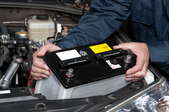
Start here. Most stuck-gear problems live in the cables or linkage, not inside the lower unit.
Disconnect the shift cable at the engine. Pull the cable end off the shift arm at the tiller or powerhead. Now try to move the engine's shift arm by hand through forward, neutral, and reverse. Does it move smoothly? If yes, your lower unit is probably fine—the problem is in the cable or control box. If the arm is stiff or won't budge, the issue is deeper, likely inside the gearcase or shift mechanism. Source
Inspect the cable for kinks, corrosion, or stretch. Old cables bind up, especially in saltwater. If the cable housing is corroded or the inner wire is frayed, replace it. A stretched cable won't pull the shift rod far enough to disengage the clutch, leaving you stuck in gear. Source
Lubricate the shift arm pivot and exposed linkage. Sometimes the pivot bushings at the engine seize up from salt or lack of grease. Hit them with marine-grade lubricant. If the arm moves freely after that, you've solved it without pulling anything apart.
Step 2: Inspect the Control Box
Remote controls wear out. Internal cams, detents, or springs can break or bind, preventing the shifter from fully engaging neutral.
Remove the control box cover and check for broken parts. Look for cracked plastic gears, worn detent balls, or springs that have popped out of place. If the internal mechanism doesn't return to neutral when you move the lever, the box needs repair or replacement. Source
Test the cable travel at the control end. Disconnect the cable at the engine, then move the control lever through its range. The cable should pull smoothly and return fully. If it sticks or doesn't return, the problem is in the control box, not the engine.
Step 3: Check for Lower Unit Misalignment After Reinstallation
If the motor got stuck in gear right after you pulled the lower unit to change an impeller or seals, you probably reinstalled it in the wrong shift position.
Lower unit must be in neutral during reinstallation. When you drop the lower unit, the shift shaft inside the gearcase has to line up with the shift rod in the mid-section. If the gearcase is in forward and the control is in neutral, the splines won't mesh correctly. When you bolt it back on, the motor stays locked in forward even though the shifter says neutral. Source
How to fix it: Drop the lower unit again. Put the helm control in neutral. Manually shift the lower unit into neutral by rotating the prop shaft while moving the shift rod inside the gearcase until you feel it click into neutral (the prop will spin freely in both directions). Now raise the lower unit, align the shift shaft splines, and bolt it on. Source
Step 4: Diagnose Internal Lower Unit Problems
If cables and controls are good but the shift arm at the engine won't move, you've got an internal problem.
Worn Dog Clutch Teeth
The dog clutch has sharp, square teeth that lock into matching recesses on the forward and reverse gears. When you shift sloppily—hesitating in the middle instead of making a decisive throw—the clutch slides into gear while the engine is still at high RPM. The teeth grind and round off. Once they're rounded, the clutch can't lock fully. It slips out of gear under load or won't engage at all.
What it sounds like: A grinding or clunking when you shift, or the motor slips out of gear when you add throttle.
Dangar Marine, a professional outboard repair specialist, explains: "When you're using an outboard gear control, be quite decisive—put it in neutral, wait for the RPMs to drop off, then put it quickly into gear. Otherwise you sort of sit on that cusp and you'll actually cause premature wear to the gearbox… it's supposed to have quite 90° corners on it; once they get rounded, instead of the dog clutch catching on the gear it starts slipping over." Source
How to fix it: Pull the lower unit, drain the gear oil, and remove the bearing carrier to access the clutch. Inspect the teeth. If they're rounded, you can machine them back to a sharp profile with a light back-cut (about 1° angle) using a grinder or mill. This costs around $32 at a machine shop versus $300+ for new gears. Clean thoroughly with compressed air, reassemble with anti-seize on the shift rod, refill with fresh gear oil, and test under load. Source
Bent or Corroded Shift Rod
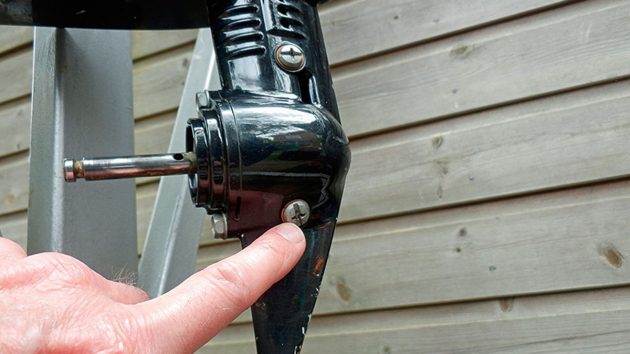
If the shift rod inside the lower unit is bent—often from hitting debris—it won't slide the clutch all the way into neutral. Corrosion can also freeze the rod in place, especially in saltwater motors that sit unused.
How to check: With the lower unit removed, try moving the shift rod by hand. It should slide smoothly through its full range. If it binds, won't move, or feels gritty, pull the rod and inspect for bends, pitting, or salt buildup. Replace the rod and bushings if damaged. Source
Shift Cover O-Ring Failure
Some models have a shift cover inside the gearcase with an O-ring seal. If that O-ring swells, hardens, or breaks, it can jam the shift mechanism. Removing the gearcase, replacing the O-ring, and cleaning the shift cover often fixes it. Source
Symptom-Based Troubleshooting Table
| Symptom | Likely Cause | Fix |
|---|---|---|
| Shifter at helm is stiff, but engine shift arm moves freely when cable is disconnected | Cable or control box binding | Replace cable; lubricate or repair control box |
| Engine shift arm won't move even with cable disconnected | Internal lower unit problem (bent rod, worn clutch, corrosion) | Drop lower unit; inspect shift rod, dog clutch, and gears |
| Stuck in forward or reverse immediately after impeller change | Lower unit reinstalled in wrong shift position | Drop lower unit; realign in neutral; reinstall |
| Grinds or clunks when shifting, then slips out of gear under throttle | Rounded dog clutch teeth | Machine clutch teeth to sharp profile or replace |
| Shifter moves but prop stays engaged in one direction | Shift rod not traveling full distance (cable stretch, linkage misadjustment, internal jam) | Adjust cable; check linkage; inspect shift rod travel |
How to Properly Adjust Shift Cables
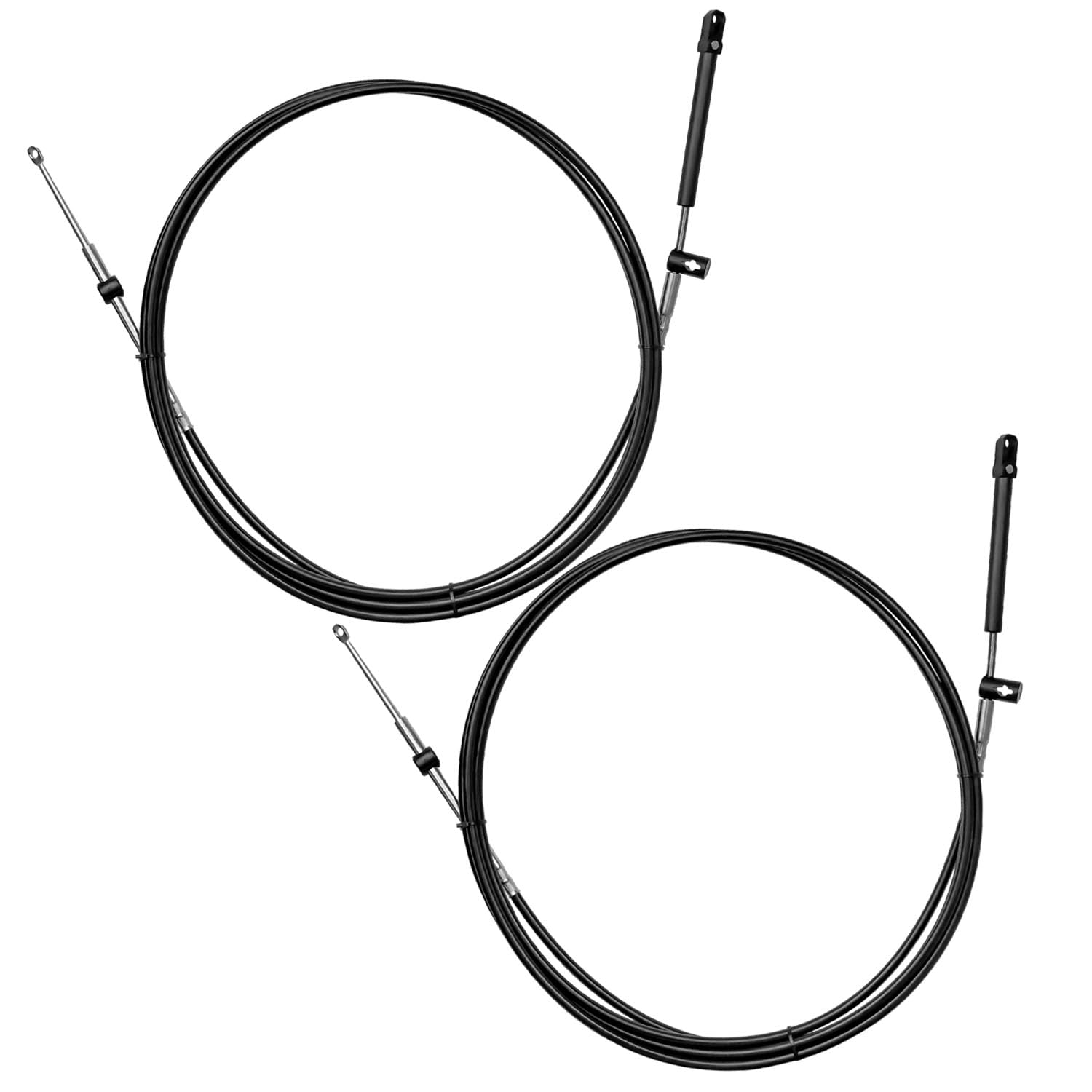
Misadjusted cables are the number-one cause of stuck-in-gear complaints. The cable has to pull the shift rod far enough to fully engage or disengage the clutch. If it's off by even a few threads, the clutch won't lock or won't release.
Standard adjustment procedure:
- Put the helm control in neutral.
- Disconnect the shift cable at the engine.
- Manually shift the engine into neutral using the shift arm on the powerhead. The prop should spin freely in both directions.
- With both the control and engine in neutral, reconnect the cable. There should be 3–4 threads showing on the cable connector. Use Loctite to lock the adjustment.
- Test by shifting through forward, neutral, and reverse. The prop should stop spinning in neutral and lock in both gears under light load.
If the cable is stretched, you won't be able to get enough threads. Replace the cable. Source
When the Problem Started After Hitting Something

Lightly hitting a sandbar, rock, or submerged log can bend the shift rod, dent the gearcase, or knock the dog clutch out of alignment. Even a small impact can burr the shift mechanism enough to prevent smooth shifting.
Case example: A 1996 Mercury 135 HP in Ocean City, Maryland hit a sandbar. Afterward, shifting from forward to neutral was stiff. Running the motor briefly in neutral eased it, but the problem came back. Diagnosis pointed to a bent shift linkage or cable stretch from the impact. Cable lubrication, realignment, and minor adjustment at the engine connection fixed it without pulling the lower unit. Source
If shifting doesn't return to normal after cable adjustment and lubrication, the lower unit needs to come off for internal inspection. Don't keep forcing it—you'll damage the gears.
Common Mistakes That Cause Stuck-Gear Problems
Sloppy shifting technique. If you hesitate halfway through the shift or shift while the engine is still at high RPM, the dog clutch grinds into the gear instead of locking cleanly. This rounds off the teeth fast. Shift decisively: throttle to idle, pause for RPM to drop, then throw the shifter quickly through neutral into the next gear.
Ignoring cable maintenance. Cables corrode, especially in saltwater. Flush the cable housing with fresh water after every saltwater trip. Lubricate the cable ends and pivot points every season. A $50 cable is cheaper than a $500 lower unit rebuild.
Reinstalling the lower unit in gear. Always confirm both the control and the gearcase are in neutral before you bolt the lower unit back on. Spin the prop to verify—it should turn freely in both directions.
Impact of Propeller Pitch on Shift Load
A propeller with too high a pitch increases the load on the dog clutch at low RPM. When you shift into gear at idle, the high-pitch prop drags harder against the water. If the clutch teeth are already slightly worn, that extra load can prevent full engagement or cause the clutch to slip immediately.
Load calculation example: A 15-inch diameter, 21-pitch prop on a 50 HP outboard at 700 RPM idle creates significantly more resistance than a 17-pitch prop. If the dog clutch is marginal, the 21-pitch prop will slip or grind during engagement, while the 17-pitch prop might lock fine. Switching to a lower-pitch prop can sometimes mask a worn clutch temporarily, but the real fix is repairing the clutch. Source
Tools You'll Need
- Metric and standard socket set
- Screwdrivers (flat and Phillips)
- Needle-nose pliers
- Marine-grade grease and lubricant
- Gear oil pump and fresh lower unit oil
- Loctite (blue, medium-strength)
- Shop rags and degreaser
- Multimeter (if testing shift cut-out switch continuity)
- Dremel or grinder (if machining clutch teeth)
- Service manual for your specific engine
Shift Cut-Out Switch: What It Does and How It Fails
Modern outboards—both two-stroke and four-stroke—often have a shift cut-out switch. This is a safety feature that momentarily reduces engine power or retards ignition timing when you move the shifter. It gives the dog clutch a split second to mesh without the engine fighting it.
How it works: When you move the shift lever, a cam or actuator closes the cut-out switch. The ECU or ignition module senses this and drops RPM or cuts spark for a fraction of a second. The clutch slides into gear smoothly, then power resumes.
How it fails: If the switch sticks closed, the engine thinks you're shifting all the time and won't rev. If the switch fails open, it never signals the ECU, so the engine doesn't drop RPM during the shift. The clutch grinds in under full power, wearing the teeth fast. A malfunctioning cut-out switch can also cause the engine to stumble or die when you shift, even though the cable and linkage are fine.
Testing the switch: Locate the switch on the control linkage (consult your service manual). Disconnect the wiring connector. Use a multimeter set to continuity mode. When the shift lever is in neutral or in gear (not moving), the switch should be open (no continuity). When you move the lever through the shift range, the switch should close briefly (continuity), then open again. If it stays closed or never closes, replace the switch. Source
Link and Sync: Why Timing Matters
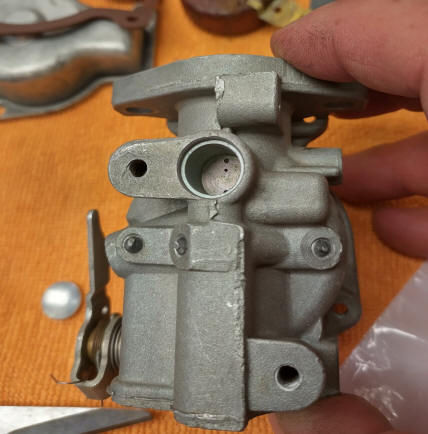
On older two-stroke outboards with carburetors, the ignition timing and carburetor throttle plate opening must synchronize during shifts. This is called "link and sync." If the timing advances before the throttle opens, or vice versa, the engine can bog or die when you shift into gear.
How to check: With the control in neutral, the timing mark on the flywheel should align with the neutral timing spec in the service manual (usually around 4–6° BTDC). As you advance the throttle, the timing should advance smoothly along with the throttle plate opening. If timing jumps ahead or lags, the linkage needs adjustment.
Common symptom: The engine idles fine in neutral but dies the instant you shift into forward or reverse, even though the clutch engages properly. Adjusting the link-and-sync rods so the throttle cracks open slightly as the shift happens often fixes it. Source
Ethanol Fuel and Phase Separation
E10 gasoline (10% ethanol) absorbs water. When the ethanol-water mix separates from the gasoline, it sinks to the bottom of the fuel system. That ethanol sludge clogs the low-speed jets in the carburetor first—exactly the jets that feed fuel at idle and during the shift transition.
Result: The engine runs fine at high throttle (main jets are clean) but stumbles, hesitates, or dies when you shift into gear (low-speed jets are clogged).
Fix: Drain the fuel system. Pull the carburetors and clean all jets, especially the pilot and idle circuits. Replace the fuel with fresh non-ethanol gas or add a fuel stabilizer if E10 is unavoidable. Run the engine to clear residual sludge. Source
For replacement parts like carburetor kits, you can find a wide selection in the carburetor repair kits collection at JLM Marine to keep your engine running smoothly.
Fishing Line and Debris Around the Prop Shaft
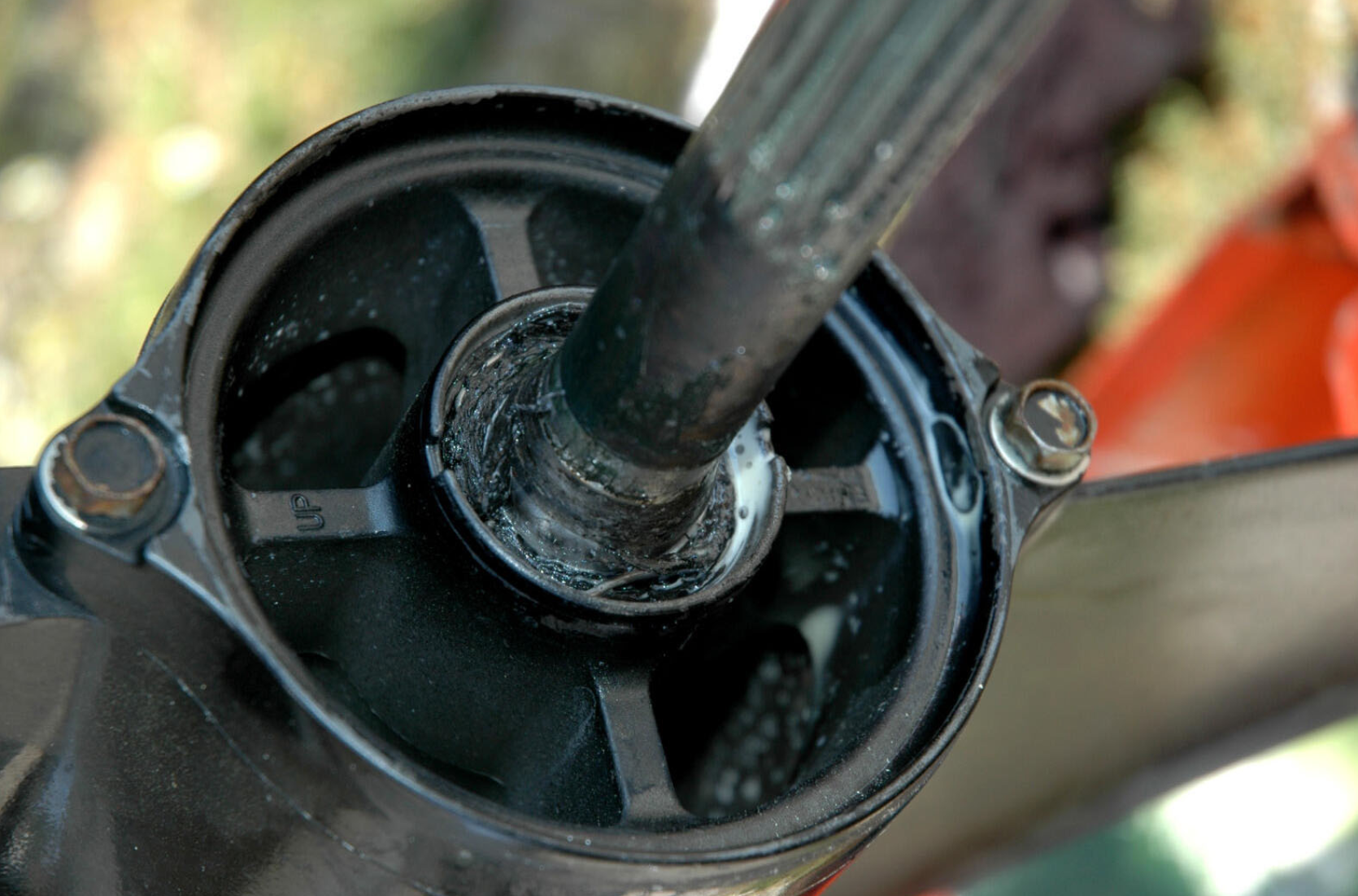
A wad of fishing line, plastic bag, or seaweed wrapped tight around the prop shaft behind the prop creates hidden drag. The engine might run fine in neutral, but the instant you shift into gear, that extra friction stalls it.
How to check: Pull the boat out of the water. Spin the prop by hand. It should turn smoothly with no grinding or resistance. If it feels tight or you hear rubbing, inspect behind the prop and around the prop shaft seal. Cut away any fishing line or debris. We've seen cases where a single strand of 80-pound braid wound around the shaft 50 times created enough drag to kill a 25 HP motor at idle when shifted into gear.
Remote Control vs. Tiller Handle Cable Differences
Remote control systems use long shift and throttle cables that run from the helm to the engine. These cables stretch over time, especially the shift cable. Cable stretch of just 1/8 inch can prevent the dog clutch from fully engaging or releasing. If you have a remote setup and the motor is stuck in gear, check cable adjustment first and inspect for kinks or corrosion in the cable housing. Source
Tiller handle engines have much shorter linkage and no long cables. If a tiller motor is stuck in gear, the problem is almost always in the shift arm pivot bushings, the shift rod inside the powerhead, or internal lower unit components. Cable stretch isn't a factor.
For shift cable replacements and parts, browse the boat accessories collection at JLM Marine to find suitable marine-grade cables and components.
Adjusting the Idle Speed Screw
If your engine dies the instant you shift into gear but runs fine in neutral, the idle RPM is too low to handle the load of the engaged prop.
How to adjust: Locate the idle speed screw on the carburetor or throttle linkage (not the mixture screw). With the engine warm and in neutral, turn the screw clockwise to increase idle RPM by 100–200. Shift into gear. The engine should stay running under the load. If it still dies, the problem is deeper (compression, ignition, fuel starvation), not just idle speed.
Target RPM: Most outboards need 700–900 RPM in neutral to hold 600–700 RPM in gear without stalling. Check your service manual for the exact spec.
For more information on maintaining idle speed and carburetor settings, see the Yamaha Outboard Carburetor Rebuild Tutorial to restore smooth operation.
When to Call a Professional

If you've checked cables, linkage, and controls, and the engine shift arm still won't move, or if the motor grinds and slips under load even with fresh cable adjustment, you need internal lower unit work. Pulling a lower unit, inspecting gears, machining clutch teeth, and replacing seals requires specialized tools and experience. Don't force it—damaged gears cost more than a professional diagnosis.
US Coast Guard accident data: Machinery failure (including drivetrain problems like stuck gears) ranks in the top five primary contributing factors in recreational boating accidents, alongside operator inattention, inexperience, improper lookout, and excessive speed. In 2022, the Coast Guard recorded 4,040 recreational boating accidents with 636 deaths, 2,222 injuries, and about $63 million in property damage. Source Continuing to run an outboard that grinds, won't fully shift, or is stuck in gear can rapidly damage gears and clutch components, increasing repair cost or causing sudden loss of propulsion in close quarters. Source
After every saltwater trip, flush your shift linkage and cable connections with fresh water from a garden hose—not just the cooling system. Salt corrosion locks up shift mechanisms faster than any other part, and a 30-second rinse prevents a $400 cable or control box replacement next season.
For quality replacement parts, consider browsing the JLM Marine HUB for marine parts to find everything you need for repairs and maintenance.
Sources
- https://www.youtube.com/watch?v=B4acSf_BgP4
- https://www.youtube.com/watch?v=ZVleLYy5Q1g
- https://www.marineengine.com/boat-forum/threads/hard-to-shift-into-and-out-of-gear.469921/
- https://www.youtube.com/watch?v=joMwcB1eS5Q
- https://checkmate-boats.com/forums/threads/stuck-in-gear.24713/
- https://www.etecownersgroup.com/post/gear-shifting-issue-5360440
- https://www.marineengine.com/boat-forum/threads/gear-shift-and-throttle-problems.216897/
- https://uscgboating.org/library/accident-statistics/Recreational-Boating-Statistics-2022-Ch1.pdf
- https://www.youtube.com/watch?v=5qGBgjGZBEQ
Hi—I’m Jim Walker
I grew up in a Florida boatyard, earning pocket money (and a few scars) by rebuilding outboard carbs before I could drive. That hands-on habit carried me through a Ph.D. in mechanical engineering, where I studied how salt water quietly murders metal.
I spent ten years designing cooling systems for high-horsepower outboards, then joined JLM Marine as CTO. We bench-test every new part in the lab, but I still bolt early prototypes onto my own 23-foot skiff for a weekend shake-down— nothing beats real wake and spray for finding weak spots.
Here on the blog I share the fixes and shortcuts I’ve learned so your engine—and your day on the water—run smooth.

Для владельцев лодок:
Мы надеемся, что следующие ресурсы окажутся полезными для вас в обслуживании и ремонте ваших судовых двигателей:
- Руководство по серийным номерам Mercury
- Руководства пользователя от Mercury
- Официальное руководство по номерам моделей в формате PDF от BRP
- Руководство по серийным номерам Johnson
-
Аксессуары для лодок от JLM Marine
О компании JLM Marine
Основанная в 2002 году, компания JLM Marine зарекомендовала себя как специализированный производитель высококачественных морских деталей, базирующийся в Китае. Наша приверженность совершенству в производстве заслужила нам доверие ведущих мировых морских брендов.
Как прямой поставщик, мы обходим посредников, что позволяет нам предлагать конкурентоспособные цены без ущерба качеству. Такой подход не только поддерживает экономическую эффективность, но и гарантирует, что наши клиенты получают наилучшую ценность напрямую от источника.
Мы рады расширить свое присутствие через розничные каналы, предлагая наш опыт и приверженность качеству непосредственно владельцам и любителям лодок по всему миру.
Распродажа лодочных аксессуаров
- $54.00
- $54.00
- Unit price
- per
- $38.50
- $38.50
- Unit price
- per
- From $39.13
$45.50- From $39.13
- Unit price
- per

- $53.50
- $53.50
- Unit price
- per
- From $54.00
- From $54.00
- Unit price
- per


- $34.50
- $34.50
- Unit price
- per
- $34.50
- $34.50
- Unit price
- per


- $54.00
- $54.00
- Unit price
- per


- $54.00
- $54.00
- Unit price
- per
- $40.00
- $40.00
- Unit price
- per
- $32.00
- $32.00
- Unit price
- per
- $23.50
- $23.50
- Unit price
- per
-
Red
-
Blue
- $45.00
- $45.00
- Unit price
- per
- $22.80
- $22.80
- Unit price
- per
-
Red
-
Blue

- $31.50
- $31.50
- Unit price
- per

- $54.00
- $54.00
- Unit price
- per
- $22.80
- $22.80
- Unit price
- per
-
Red
-
Blue


- $59.00
- $59.00
- Unit price
- per

- $32.00
- $32.00
- Unit price
- per

- $22.80
$27.00- $22.80
- Unit price
- per