


Fuel Additives Showdown: Do Cleaners and Stabilizers Work?
- What Fuel Cleaners Actually Do
- Fuel Stabilizers: When You Actually Need Them
- The GDI Problem Cleaners Can't Solve
- When Additives Work vs. When They Don't
- Diesel Additives: Different Chemistry, Different Needs
- What's Already in Your Fuel
- Additive Chemistry: PEA vs. PIBA vs. PIB
- Real-World Results: What to Expect
- Dosage and Frequency: How to Use Additives Correctly
- Contraindications: When Not to Use Additives
- Additives That Don't Belong in Fuel Systems
- Selecting the Right Additive
- Troubleshooting: Additive vs. Mechanic
- What the EPA and FTC Say
- OEM vs. Aftermarket Additives
- Storage Checklist for Fuel Stabilizers
- Buyer's Checklist: What to Look for on the Bottle
- When to Skip the Additive
- Fuel Filter Maintenance After Using Additives
- Frequently Asked Questions
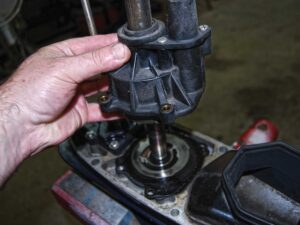
I've been wrenching on outboards for 20 years, and fuel additives are probably the second-most-asked question I get after "why won't it start?" People want to know if those bottles at the parts counter actually do anything or if they're wasting money. The short answer: some work, most are oversold, and none will fix a busted engine.
What Fuel Cleaners Actually Do
.jpg)
Fuel system cleaners use detergents to dissolve carbon deposits on injectors, intake valves, and combustion chambers. The active ingredient that matters is polyetheramine (PEA)—it breaks down carbon like dish soap cuts grease. Cheaper bottles use weak solvents or polyisobutylene (PIB), which don't clean as aggressively.
AAA's independent testing confirmed that quality additives reduce valve and injector deposits and slow new buildup. But the key word is quality. Most budget cleaners contain minimal PEA and need multiple bottles over weeks to show results. Higher-concentration formulas can improve fuel economy up to 5.7% in engines with existing deposits, according to controlled fuel economy studies.
I worked on a 2015 Mercury 75HP last month that had a rough idle and hesitation at throttle-up. Borescope showed heavy carbon on the intake valves. After a bottle of Techron Concentrate Plus (which has high PEA content), the idle smoothed out and throttle response improved. The carbon didn't disappear completely—you could still see residue on the borescope—but the spray pattern on the injectors was noticeably better.
Fuel Stabilizers: When You Actually Need Them

Stabilizers prevent fuel oxidation and the formation of gum and varnish. Ethanol-blend fuels absorb moisture and degrade fast—untreated E10 can start forming deposits in 30 days. A stabilizer slows this process.
Project Farm's 5-year test compared STA-BIL, Star Tron, Yamalube, K100, and SeaFoam. STA-BIL and Star Tron showed minimal corrosion on pot metal inside treated E10 fuel after 3 years. Untreated fuel had significant corrosion and visible sediment. One tester on BobIsTheOilGuy stored fuel with Star Tron at one ounce per 6 gallons and STA-BIL at 2 ounces per 2.5 gallons for a year. Both kept the fuel usable; untreated fuel turned dark and smelled sour.
If you're storing an outboard for winter or leaving a boat in the slip for more than a month, stabilizer is mandatory. I've pulled carbs on engines that sat for one season without it—varnish coats the bowl, the jets are clogged, and you're looking at a rebuild or replacement. For detailed advice on carburetor service, check out this Carburetor Rebuild Tutorial.
The GDI Problem Cleaners Can't Solve
Most fuel additives can't clean intake valves on gasoline direct injection (GDI) engines. In GDI systems, fuel sprays directly into the combustion chamber, bypassing the intake valves. This means the detergent never touches the valves, and carbon builds up from crankcase vapors recirculated through the PCV system.
For GDI engines, you need walnut shell blasting or manual cleaning. If you've got a GDI outboard (some newer Yamaha and Suzuki models use it), don't expect a fuel cleaner to fix valve deposits. You'll need a shop with media blasting equipment.
When Additives Work vs. When They Don't
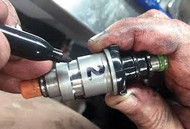
Additives work best as preventive maintenance for mild-to-moderate deposits. They won't fix:
- Physical blockages (debris in the fuel line)
- Worn injector seals or nozzles
- Mechanical issues like low compression or a failing fuel pump
- Heavy carbon buildup that's been baking on for years
I had a guy bring in a 2008 Honda 90HP with a P0300 misfire code (random cylinder misfire). He'd dumped three bottles of SeaFoam in the tank over two months. The problem was a cracked injector body leaking fuel into the intake. No amount of cleaner was going to seal that crack—he needed a new injector.
If you've got persistent misfires, hard starting, or power loss that doesn't improve after one or two treatments, stop adding bottles and bring it to a shop. You're chasing a mechanical fault, not a deposit issue. For more troubleshooting on rough idle and misfire causes, see Engine Misfires and Runs Rough: Ignition or Fuel?.
Diesel Additives: Different Chemistry, Different Needs
Diesel fuel has its own issues. Ultra-low sulfur diesel (ULSD) has less lubricity than older formulations, which can wear injector pumps. Diesel additives typically include:
- Lubricity improvers to protect the high-pressure fuel pump
- Cetane boosters (look for a 3-point cetane increase minimum on the label)
- Anti-gel agents to prevent waxing in cold weather
- Biocide to kill algae growth in fuel tanks (common in marine diesels)
For cold climates, an anti-gel additive is critical. Diesel starts to gel around 10-15°F depending on the blend. I've seen fuel filters completely plugged with wax on a Yanmar diesel that sat overnight in 5°F weather without treatment. The engine cranked but wouldn't fire—fuel couldn't pass through the filter.
If you run a diesel outboard or inboard, use an additive that's ASTM D975 compliant for lubricity and cetane. Check the label for the specific ASTM standard—it's the only way to verify the product meets baseline fuel specs.
What's Already in Your Fuel
Most pump gas already contains detergents. The EPA mandates minimum detergent levels under ASTM D4814, but "minimum" is the key word. Top Tier™ certified gasoline uses higher detergent concentrations than EPA minimums—brands like Shell, Chevron, and Mobil meet this standard.
If you're running Top Tier fuel consistently, aftermarket cleaners are mostly redundant. They act as insurance if you fill up at a no-name station with cheap fuel. If you're already using Top Tier and your engine is well-maintained, you're not going to see big gains from adding a bottle of cleaner every tank.
Aftermarket additives differ from in-fuel detergents mainly in concentration. A bottle of Techron is a concentrated dose of PEA; Top Tier fuel has PEA but at a lower, maintenance-level concentration mixed at the refinery.
Additive Chemistry: PEA vs. PIBA vs. PIB
Not all detergents are equal. Here's the breakdown:
- Polyetheramine (PEA): The strongest cleaner. Works on intake valves, injectors, and combustion chambers. Found in Techron, Redline SI-1, and higher-end products.
- Polyisobutylene amine (PIBA): Mid-grade. Good for injectors, less effective on intake valves. Common in mid-price cleaners.
- Polyisobutylene (PIB): Weak. Mostly prevents new deposits rather than cleaning existing ones. Found in cheap bottles.
If the label doesn't list the active ingredient, it's probably PIB. Look for products that specifically mention PEA or PIBA. The concentration matters too—some bottles are 50% PEA, others are 10%. More is generally better, but check the dosage instructions.
Real-World Results: What to Expect
A Cleveland user on BobIsTheOilGuy documented results with Justice Bros. Advanced Formula FI Cleaner on a Ford Focus 2.0 DOHC. Before treatment, the car got 290-300 miles per tank. After one bottle, fuel economy increased to 320-340 miles per tank and stayed consistent over three fill-ups. That's roughly a 10% improvement.
Another test using Redline SI-1 showed direct injector tips went from heavy carbon buildup to clean, and MPG increased by 10%, translating to 43 additional miles of range in a 17-gallon tank.
These are best-case scenarios on engines with existing deposits. On a clean engine, don't expect miracles. Results are gradual—one full tank for light deposits, several treatments for heavier buildup.
Dosage and Frequency: How to Use Additives Correctly
Always follow the label. Overdosing can clog fuel filters or cause rough idle. Most cleaners recommend one bottle per 12-20 gallons of fuel.
For maintenance dosing, add a bottle every oil change (roughly every 3,000-5,000 miles or 100 engine hours on an outboard). For problem-solving, you might need two or three consecutive treatments, but if you don't see improvement after that, stop—it's not a deposit issue.
For fuel stabilizers, add the product when you fill the tank for storage. Run the engine for 10 minutes to circulate treated fuel through the system. STA-BIL recommends 1 ounce per 2.5 gallons for 12-month storage, 2 ounces per 2.5 gallons for 24-month storage.
Don't store fuel longer than the stabilizer's rated period. Even treated fuel degrades—stabilizers slow the process, they don't stop it.
For more on storing your engine and fuel care, see Winterizing Kits vs. DIY Supplies: What Do You Really Need?.
Contraindications: When Not to Use Additives
Some manufacturers explicitly warn against aftermarket additives. Check your owner's manual. Mercury Marine, for example, has specific guidelines about fuel treatments—some formulas can damage O-rings in the fuel system.
Avoid additives if:
- Your outboard is under warranty and the manual prohibits them
- You're running a two-stroke with pre-mixed oil (the additive can interfere with oil dispersion)
- The engine has a flex-fuel system designed for E85 (some additives aren't compatible with high-ethanol blends)
If you're unsure, call the manufacturer's tech line with the additive's product number and ask.
Additives That Don't Belong in Fuel Systems
Stay away from "leak stop" additives marketed for fuel systems. These products contain suspended particles designed to plug small leaks. In a cooling system, they're already sketchy—they can clog heater cores and restrict flow in narrow passages. In a fuel system, they'll clog injectors and filters.
I pulled a VST (vapor separator tank) filter on a Yamaha F150 that had some kind of "fuel system sealer" dumped in the tank. The filter screen was completely blocked with a gummy residue. The high-pressure fuel pump starved, and the engine stalled at wide-open throttle. The owner paid for a new VST filter, fuel pump inspection, and a full tank drain. Don't use that stuff.
If you want to maintain your fuel and vapor separator system properly, consider browsing the Fuel & Induction parts collection.
Selecting the Right Additive
For gasoline outboards (maintenance): Use a PEA-based cleaner like Techron Concentrate Plus or Redline SI-1. Dosage: one bottle per tank every 3-5,000 miles or 100 engine hours.
For gasoline outboards (storage): Use STA-BIL Marine or Star Tron. Dosage: follow label for storage duration (typically 1 oz per 2.5 gallons for 12 months).
For diesel outboards/inboards (maintenance): Use a diesel-specific additive with lubricity improvers and cetane boost. Look for ASTM D975 compliance on the label. Examples: Stanadyne Performance Formula, Power Service Diesel Kleen.
For diesel (winter storage or cold climates): Add an anti-gel product rated for your expected low temperature. Dosage: follow label, but generally 16 oz per 40 gallons for sub-zero protection.
For diesel (algae issues): Use a biocide like Biobor JF. Dosage: 1 oz per 80 gallons for prevention, higher for active contamination. Only use biocide if you've confirmed biological growth—don't use it as routine maintenance.
Price-to-value rule: expect to pay at least $12-$15 for a 12-16 oz bottle of effective PEA cleaner. Anything cheaper is likely diluted or PIB-based. Don't buy the $5 bottle at the discount chain—it's mostly kerosene with a splash of detergent.
For parts to keep your engine running smoothly after fuel system maintenance, explore Fuel Filter and Fuel Pump collections.
Troubleshooting: Additive vs. Mechanic
| Symptom | Try Additive? | Call Mechanic? |
|---|---|---|
| Slight hesitation at throttle-up, no codes | Yes (1-2 treatments) | If no improvement after 2 tanks |
| Rough idle, improves with RPM | Yes (check for vacuum leaks first) | If persists after 1 treatment |
| Hard starting, cranks but won't fire | No | Yes (fuel pump, compression, ignition) |
| Misfires with P030X codes | Try 1 treatment | If code returns, yes |
| Stalling at idle or wide-open throttle | No | Yes (fuel pressure, air intake, ECU fault) |
| Black smoke or excessive fuel smell | No | Yes (rich mixture, injector leak, O2 sensor) |
| Knocking/pinging that increases with RPM | No | Yes (ignition timing, low octane, carbon buildup needing manual cleaning) |
If you see no improvement after two full tanks with a quality additive, stop. You're dealing with a mechanical fault that needs hands-on diagnosis.
What the EPA and FTC Say
The EPA and FTC both warn against exaggerated claims. The FTC has issued advisories about fuel additive advertising, noting that driving habits—acceleration, braking, tire pressure—have a far bigger impact on fuel economy than most additives.
The EPA sets baseline fuel standards, but aftermarket products aren't required to prove their claims unless they make specific emissions or mileage promises. That's why you see vague language like "may improve performance" instead of "increases MPG by X%."
Look for products that are EPA-registered. Registration doesn't guarantee effectiveness, but it means the product met basic environmental and safety standards and won't harm emissions equipment.
OEM vs. Aftermarket Additives
OEM-branded additives (like Yamaha Ring Free or Mercury Quickleen) are good quality but overpriced. You're paying for the logo. A bottle of Yamaha Ring Free runs $18-$20 for 8 oz. Techron Concentrate Plus is $12 for 12 oz and uses the same PEA chemistry.
Cheap no-name additives are the opposite problem—they're often just diluted solvents. Some factories that manufacture for OEM brands use excess capacity to produce non-OEM products under different labels, and these can be high quality. The challenge is identifying which ones. JLM Marine, for example, manufactures additives to factory specs without the dealership markup.
Stick with brands that publish their active ingredients and have a track record: Techron, Redline, Royal Purple, Sea Foam (for stabilization), STA-BIL, Star Tron, Lucas, and Stanadyne (diesel).
Storage Checklist for Fuel Stabilizers

When putting an outboard away for the season:
- Fill the tank completely (minimizes air space and condensation)
- Add stabilizer at the recommended dosage (follow label for storage duration)
- Run the engine for 10 minutes (circulates treated fuel through the fuel system, VST, and injectors)
- Fog the engine if it's a two-stroke or if the manual recommends it
- Check the fuel/water separator and drain any water
- Store in a cool, dry location (heat accelerates fuel degradation even with stabilizer)
Don't skip the run-time. If you add stabilizer and shut it down immediately, untreated fuel sits in the VST and fuel rails. That fuel will degrade and cause starting issues in the spring.
For detailed steps on winter prep, see Winterizing Kits vs. DIY Supplies: What Do You Really Need?.
Buyer's Checklist: What to Look for on the Bottle
When you're standing in the aisle staring at a wall of bottles, look for:
- PEA or PIBA listed as an active ingredient (not just "detergents")
- EPA registration number (usually on the back label)
- Specific dosage instructions (e.g., "1 bottle treats 20 gallons")
- ASTM compliance for diesel products (D975 for lubricity, D613 for cetane)
- Manufacturer's contact info (reputable companies list a phone number or website)
Skip it if the label says:
- "Miracle formula" or "secret blend" (no ingredient disclosure)
- "Treats 100 gallons" for a 4 oz bottle (impossibly diluted)
- Claims like "triple your MPG" (exaggerated and FTC would flag it)
When to Skip the Additive
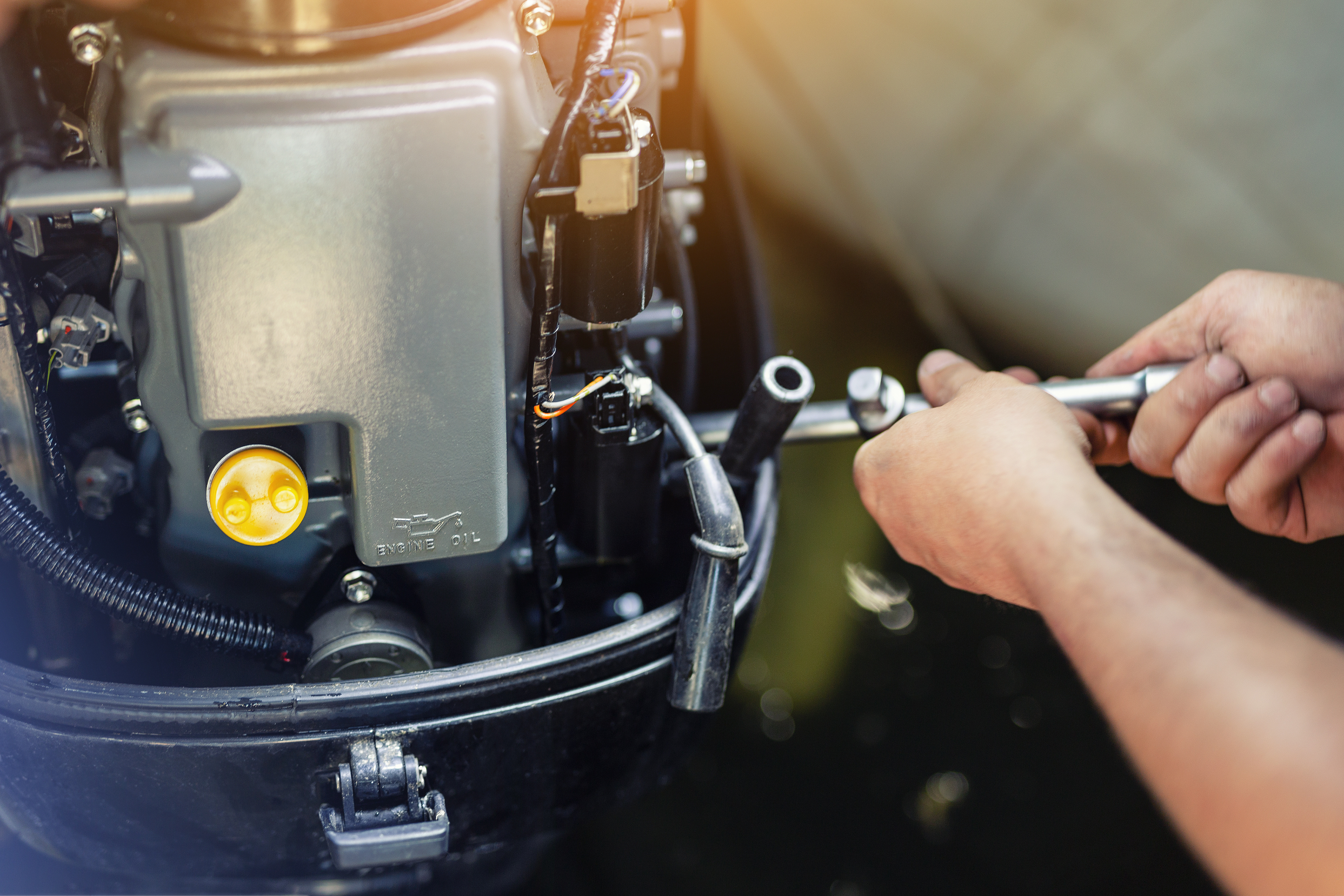
Don't bother with a fuel additive if:
- You consistently run Top Tier certified fuel and your engine is well-maintained
- Your outboard is brand new or under 50 hours (no deposit buildup yet)
- You've got a two-stroke that's already running premix oil (the oil has detergents)
- You're experiencing hard faults like no-start, loss of compression, or ECU error codes unrelated to fuel quality
Additives are maintenance tools, not repair tools. If your VST screen is clogged with debris, your fuel pump is weak, or your injectors are physically damaged, a bottle of cleaner won't fix it. You need a wrench, not a bottle.
For replacement parts after fuel system issues, visit the Inboard & Outboard Motor Parts collection.
Fuel Filter Maintenance After Using Additives
Additives can dislodge deposits, and those deposits have to go somewhere. They'll end up in your fuel filter or VST screen. After running a cleaner, especially the first time, check and replace your fuel filter. On outboards, also check the VST filter screen.
I've seen VST screens clogged after a heavy-duty cleaner loosened years of varnish in a tank. The engine ran fine for the first hour, then started starving for fuel at wide-open throttle. Pulled the VST, and the screen was coated in brown gunk. Cleaned the screen, replaced the main fuel filter, and it ran perfect.
Make it a habit: if you use a fuel system cleaner, plan to inspect and possibly replace your fuel filter within the next 10-20 engine hours.
Explore the Fuel Filter parts collection to find the right components to keep your engine fuel system clean and running strong.
Frequently Asked Questions

Do fuel additives really improve gas mileage?
Quality fuel injector cleaners with high PEA content can improve fuel economy by 5-10% in engines with existing carbon deposits. Tests with Redline SI-1 showed a 10% MPG increase after cleaning heavy carbon buildup on injectors, translating to 43 additional miles per tank in a 17-gallon tank. For well-maintained engines running Top Tier fuel, the improvement is minimal—maybe 1-2% at best. Don't expect gains if your engine is already clean.
Are fuel stabilizers necessary for my outboard?
Yes, if you're storing the engine for more than 30 days. Ethanol-blend fuels (E10) degrade fast and absorb moisture. Project Farm's long-term test showed untreated E10 fuel developed significant corrosion and sediment after one season, while STA-BIL and Star Tron treated fuel stayed clean for 3 years. For daily or weekly use, stabilizers aren't necessary—the fuel cycles through too fast to degrade.
Can fuel additives harm my engine?
Overdosing or using the wrong product can cause issues. Too much cleaner can clog fuel filters with dislodged deposits or cause rough idle. Some additives aren't compatible with flex-fuel systems or certain O-ring materials in older outboards. Always follow the label dosage, check your owner's manual for contraindications, and avoid "leak stop" products that contain suspended particles—they'll clog injectors and VST screens.
What fuel additive should I use for my diesel outboard?
Use a diesel-specific additive with lubricity improvers and a cetane boost of at least 3 points. Look for ASTM D975 compliance on the label. For cold climates, add an anti-gel product rated for your expected low temperature. For algae contamination (common in marine diesel tanks), use a biocide like Biobor JF at 1 oz per 80 gallons. Don't use gasoline additives in diesel—they're chemically different and won't address diesel-specific issues like waxing or injector pump wear.
How often should I use fuel additives?
For maintenance, add a PEA-based cleaner every oil change—roughly every 3,000-5,000 miles or 100 engine hours on an outboard. For problem-solving (rough idle, hesitation), run two consecutive treatments and stop if you don't see improvement. For stabilizers, add them only when storing fuel for 30+ days—there's no benefit to using them in active engines. Follow the label for storage duration: STA-BIL recommends 1 oz per 2.5 gallons for 12-month storage, double that for 24 months.
Are the additives already in Top Tier gasoline enough?
For most well-maintained engines, yes. Top Tier gasoline contains higher detergent concentrations than EPA-minimum fuel and keeps injectors and valves clean under normal use. Aftermarket cleaners act as insurance if you occasionally fill up at low-quality stations or as problem-solvers for engines with existing deposits. If you run Top Tier consistently and follow your maintenance schedule, you don't need to add a bottle every tank. Save the cleaner for engines with high mileage, short-trip driving patterns, or visible performance issues.
After you run a fuel system cleaner, check your fuel filter within the next 10-20 engine hours and replace it if it's discolored or clogged—the cleaner will dislodge deposits, and you want your filter catching them, not your injectors.
For additional resources and a wide range of marine parts, be sure to visit JLM Marine: Direct from Factory Boat Parts | Free Worldwide Shipping.
Hi—I’m Jim Walker
I grew up in a Florida boatyard, earning pocket money (and a few scars) by rebuilding outboard carbs before I could drive. That hands-on habit carried me through a Ph.D. in mechanical engineering, where I studied how salt water quietly murders metal.
I spent ten years designing cooling systems for high-horsepower outboards, then joined JLM Marine as CTO. We bench-test every new part in the lab, but I still bolt early prototypes onto my own 23-foot skiff for a weekend shake-down— nothing beats real wake and spray for finding weak spots.
Here on the blog I share the fixes and shortcuts I’ve learned so your engine—and your day on the water—run smooth.

Para propietarios de motores fuera de borda:
Para ayudarlo a mantener y reparar sus motores marinos, esperamos que los siguientes recursos puedan serle de utilidad:
-
Bombas de combustible de JLM Marine
-
Kits de bomba de combustible de JLM Marine
- Kit de bomba de combustible
- Kit de bomba de combustible Yamaha
- Kit de bomba de combustible Mercury
- Kit de bomba de combustible Johnson
- Kit de bomba de combustible Evinrude
- Kit de bomba de combustible Suzuki
- Kit de bomba de combustible Honda
- Kit de bomba de combustible Tohatsu
- Kit de bomba de combustible Volvo
Acerca de JLM Marine
Fundada en 2002, JLM Marine se ha consolidado como un fabricante dedicado de piezas marinas de alta calidad, con sede en China. Nuestro compromiso con la excelencia en la fabricación nos ha ganado la confianza de las principales marcas marinas a nivel mundial.
Como proveedor directo, evitamos intermediarios, lo que nos permite ofrecer precios competitivos sin comprometer la calidad. Este enfoque no solo promueve la rentabilidad, sino que también garantiza que nuestros clientes reciban el mejor valor directamente del proveedor.
Estamos entusiasmados de ampliar nuestro alcance a través de canales minoristas, llevando nuestra experiencia y compromiso con la calidad directamente a los propietarios de embarcaciones y entusiastas de todo el mundo.
Bomba de combustible en venta
- $73.50
$88.00- $73.50
- Unit price
- per
- $16.00
$0.00- $16.00
- Unit price
- per
- $17.99
$21.00- $17.99
- Unit price
- per

- $21.99
$19.00- $21.99
- Unit price
- per

- $45.99
$55.00- $45.99
- Unit price
- per

- $18.99
$15.00- $18.99
- Unit price
- per

- $28.99
$34.00- $28.99
- Unit price
- per

- $23.59
$28.00- $23.59
- Unit price
- per
- $46.50
$60.00- $46.50
- Unit price
- per

- $21.99
$19.00- $21.99
- Unit price
- per
- $26.80
- $26.80
- Unit price
- per
- $24.80
- $24.80
- Unit price
- per
- $28.90
- $28.90
- Unit price
- per

- $56.99
- $56.99
- Unit price
- per

- $27.77
$22.00- $27.77
- Unit price
- per

- $129.95
$155.00- $129.95
- Unit price
- per

- $31.20
$37.00- $31.20
- Unit price
- per
- $138.00
- $138.00
- Unit price
- per

- $129.95
$155.00- $129.95
- Unit price
- per
- $24.80
$45.00- $24.80
- Unit price
- per